

One of our newsletter subscribers wrote to me last week:
“I often find myself overwhelmed with many possible ideas, and struggle with choosing one that balances significance, practicality, and publication potential.”
That’s a common challenge.
Early in my career, I had dozens of half-baked projects because I didn’t know how to systematically narrow focus.
Over the years (and with a few grey hairs), I developed a simple 5-step system that makes the process deliberate, not chaotic.
Here’s how it works.
1️⃣ Frame the Problem/Gap/Hook
Every impactful research question starts with clarity about why it matters.
Think of it as the scholarly version of storytelling:
- Problem = what’s at stake.
- Gap = what’s missing.
- Hook = why it’s worth answering now.
This framing ensures you’re not just asking “an interesting question,” but one that adds to the scientific conversation. Loralei Lingard, PhD, calls this the scholarly conversation test: if you can’t show how your question fits into (and advances) the conversation, it won’t resonate.
Example (Hypertension):
- Problem: Hypertension is the leading global risk factor for cardiovascular disease.
- Gap: Most outcome trials have focused on Western populations; little is known about optimal BP targets in South Asian patients.
- Hook: South Asians face stroke at younger ages — a chance to inform guidelines.
👉 If you can’t write your Problem/Gap/Hook in 2–3 sentences, your idea isn’t ready.
2️⃣ Apply the Feasibility Filter
Great ideas fail when they can’t be executed. That’s where feasibility comes in.
Feasibility isn’t just about having enough patients for statistical power. It starts much earlier, at the design stage. Do you have access to reliable data? Are the variables well captured? Is the timeline realistic?
The feasibility filter forces you to trade “nice to have” for “possible to do.”
Example (Diabetes):
- Good question: “Does early statin use in type 2 diabetes reduce risk of first MI?”
- ✅ Diabetes, prescriptions, and MI outcomes are reliably captured in large EHRs.
- ✅ Plenty of patients = statistical power.
- Weak question: “Do lifestyle interventions prevent diabetes complications worldwide?”
- ❌ Too many confounders. No clear exposure or outcome.
- ❌ No single dataset can answer it.
Feasibility = data access + valid measures + sufficient power.
👉 No dataset is perfect. You’ll make compromises. Just make sure they don’t undermine your main question.
3️⃣ Find the Impact Sweet Spot
This is where ambition meets reality. A question has to land in the “impact zone”: significant enough to matter, novel enough to be interesting, and feasible enough to be done.
Most early researchers stumble by leaning too far in one direction: too broad, too narrow, too safe, or too ambitious. The sweet spot is where your work is doable and moves the needle.
Example (Cardiovascular disease):
- Too broad: “What are all the risk factors for heart disease?”
- Too narrow: “Does coffee intake increase LDL in Nepalese men aged 20–25?”
- Too safe: “Do beta-blockers reduce heart rate?”
- Too ambitious: “Can AI predict all-cause mortality in every patient worldwide?”
- Sweet spot: “In heart failure with preserved EF, does obesity modify response to SGLT2 inhibitors?”
👉 Novel. Doable. Clinically meaningful.
4️⃣ Validate with AI and Peers/Mentors
The old way to validate an idea was spending months buried in PubMed. Today, you can do it in hours if you combine AI with peer input.
Here’s how:
- Start with AI-based semantic search for a quick scan of related work.
- Use tools like Deep Research (ChatGPT, Gemini, or Perplexity) to review the first set of papers systematically.
- Then, do a targeted PubMed keyword search to confirm the coverage.
- Finally, share your one-paragraph pitch with a colleague or mentor. Their instant reaction is often the best test.
Example (Hypertension): Semantic search shows dozens of trials on intensive BP lowering. Keyword search reveals only a handful in patients ≥80. That’s the gap.
👉 If both the literature and your peers validate it, you’re on solid ground.
5️⃣ Pass the One-Sentence Test
A refined question is one you can state in one crisp sentence. If you can’t do that, it’s still too messy.
Examples:
- ❌ “I want to look at diabetes and heart disease.”
- ✅ “Among adults with type 2 diabetes, what is the effect of early statin initiation on 10-year risk of first myocardial infarction?”
- ❌ “I want to study hypertension in the elderly.”
- ✅ “In patients ≥80 years, does intensive BP lowering (<120 mmHg) vs. standard control (<140 mmHg) reduce risk of stroke without increasing falls?”
👉 Clarity = power.
Putting It All Together
The formula is simple but not easy:
Problem/Gap/Hook → Feasibility → Impact → Validation → One-Sentence Test.
This is the process I wish someone had given me when I started. It would have saved me years of chasing half-baked projects.
If you had to frame one new question today in your own field, what would it look like in this format?
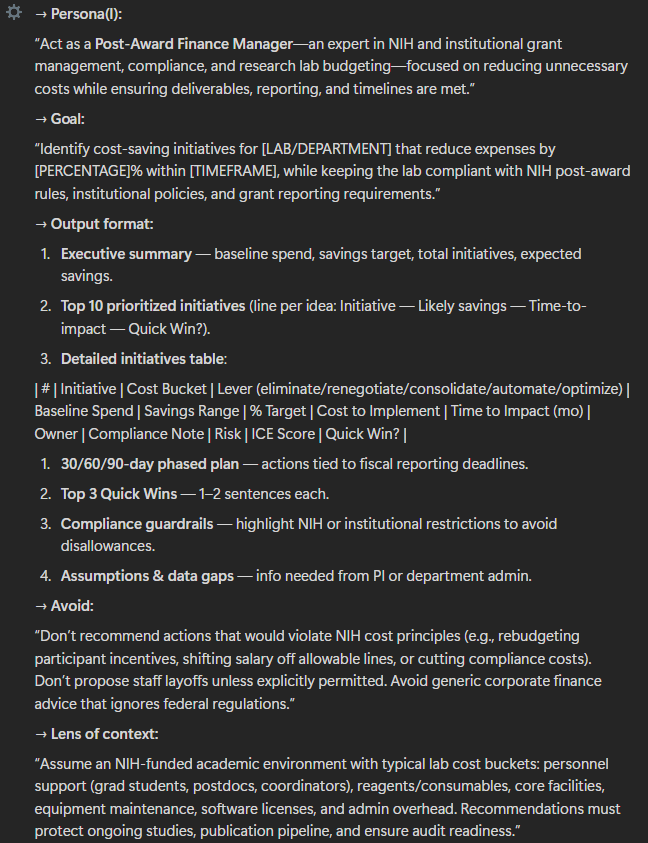
PROMPT OF THE WEEK:
Research Lab Cost-Saving Prompt (Post-Award Finance Manager)
P.S. After a year and half of toiling, engineering, and problem-solving (one after the other), we are finally launching Research Boost. I am running a launch event webinar where I will be showing ” How to Leverage AI for Clinical Research (with Research Boost)” next Saturday 9/06/2025, 10 to 11 am CST (11am to 12 pm CST). Hope to see you there.
Sign up here FREE today (spots are limited): https://risingresearcheracademy.com/aitraining/