

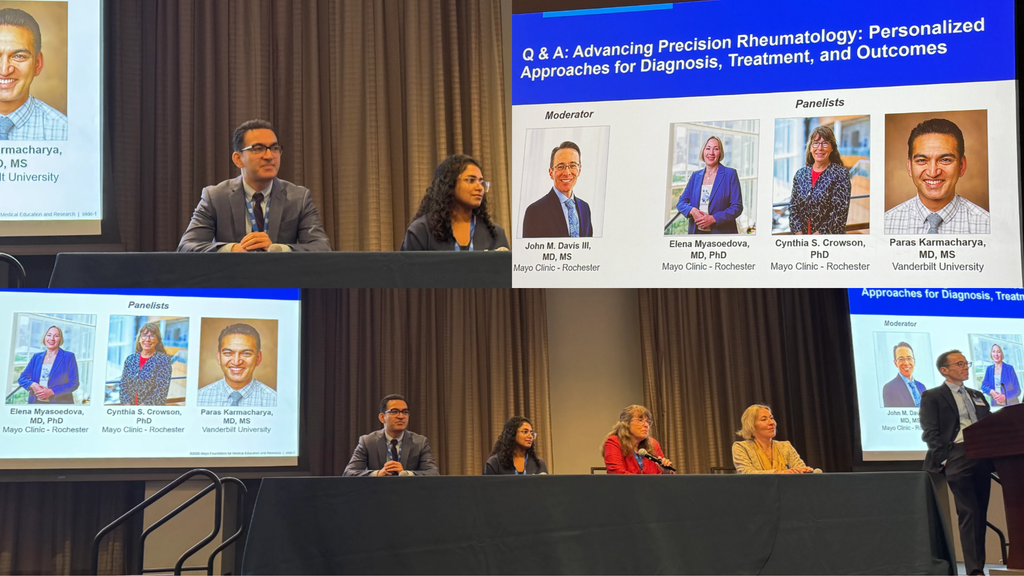
At the Mayo Clinic Rheumatology Centennial Celebration, someone in the audience asked a question I have not stopped thinking about.
“What’s the point in teaching the next generation of doctors and researchers when AI can do it all?”
AI writes, codes, and summarizes faster than most of us. This fall, it also did something many mathematicians thought was decades away.
I think that math story, read carefully, is one of the strongest arguments for training more researchers, not fewer.
👋🏽 Quick announcement: Research Boost 2.0 is live. It is an AI academic writing agent that works with you on your research. Try it here: https://researchboost.com/
1. Five weeks that shook mathematics
On September 8, OpenAI announced that roughly 10,000 AI agents running on an unreleased model had shown that the Navier-Stokes equations, which describe how fluids flow, can blow up. That question is one of the Clay Institute’s $1 million Millennium Prize Problems. The proof took about 88 hours and was checked in Lean, a programming language that verifies proofs line by line.
Four weeks later, OpenAI released 722 manuscripts covering 372 families of results. Each took about three hours of model thinking time, and nearly every one came from a single prompt handed to a single agent.
I will be honest. I do not understand most of this math. Math like this is one of the reasons I chose a biology major in undergrad. So I read the coverage the way most of you will, trying to work out what it means for the rest of us.
Many mathematicians reacted with anger. One group called the release a demonstration of power rather than scholarship. Within a day, OpenAI withdrew three of the manuscripts. A single sign error had invalidated one paper and the construction two others were built on.
2. What mathematicians are actually worried about
Many commenters assumed mathematicians were simply afraid for their jobs. The deeper worry applies to every researcher.
In 1735, Leonhard Euler solved a puzzle with no practical value. Could you walk across all seven bridges of Königsberg without crossing any bridge twice? The answer was no, and nobody needs it today.
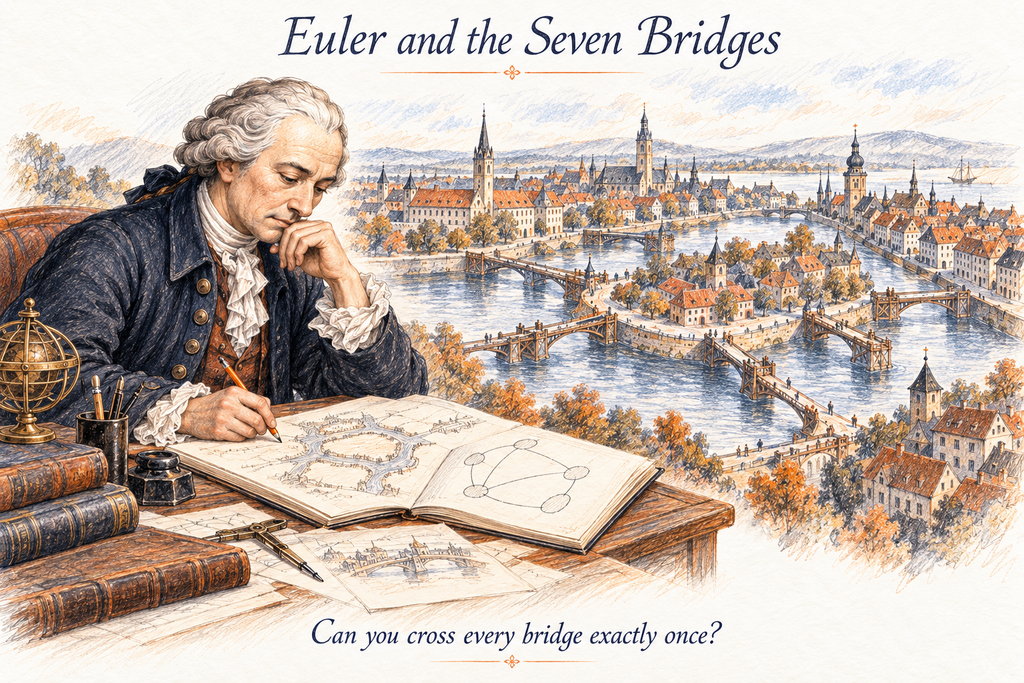
What mattered was how Euler got there. He stripped the city down to land masses and connections, and that abstraction helped found graph theory. Today it underpins internet routing, logistics, and the network analyses in many genetics papers. Had Euler typed the question into a chatbot and received “No,” we might have the answer without the field.
Navier-Stokes fits that pattern. The singularity result has no immediate practical payoff, and it stands on human shoulders. Both AI-assisted teams leaned heavily on a strategy from two human mathematicians, Diego Córdoba and Luis Martínez-Zoroa. Humans picked the approach that made the AI proof possible.
There is a second worry: the pipeline. If a gifted 17-year-old reads a new “AI solves famous problem” headline every week, why commit a decade to a PhD? Clinical research has the same pipeline. If trainees decide the work is already done, we will run short of people who can tell when an AI-generated analysis is wrong.
3. Math is the easiest case for AI. Medicine is one of the hardest.
Mathematics has something most fields lack: an answer key you can build. A proof is right or wrong, and Lean can check it. That checkability is why math fell first. Ethan Mollick calls this uneven pattern the jagged frontier: superhuman in some domains, unreliable in others.
Code is checkable too, and labs have poured money into coding models. Yet senior engineers still wrap AI-generated code in tests, restricted permissions, and review, because the model does not know which question to ask. As someone building an AI research tool, I have never needed good engineers more.
A clinical research question looks very different from a proof. Which confounders matter? Which outcome do patients care about? Is this association causal, or did we just measure who gets referred to an academic center?
Medicine has no Lean. No answer key.
When I left math behind for biology, I did not know I was picking the field AI would find hardest to master.
4. The Jevons paradox: why cheaper work creates more work
In 1865, the economist William Stanley Jevons published The Coal Question. Steam engines were getting more efficient, and many expected Britain to burn less coal. Jevons argued the opposite. Cheaper energy made steam power worth using in far more places, so total coal use climbed.
When something gets cheaper to use, we find many more uses for it.
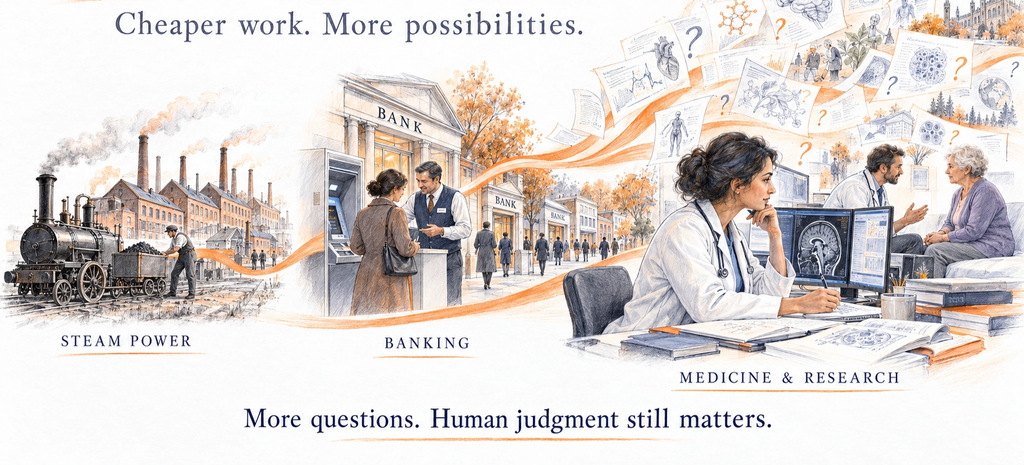
ATMs. ATMs were supposed to end bank tellers. Between 1988 and 2004, the tellers needed per urban branch fell from 20 to 13. Branches got cheaper to run, banks opened 43% more of them, and teller jobs held. The work shifted from counting cash to solving problems and building relationships.
Radiology. In 2016, Geoffrey Hinton said we should stop training radiologists. Since then, Mayo Clinic’s radiology staff has grown 55% to 400 radiologists, alongside more than 250 AI models. Hinton has since said he spoke too broadly.
Research. An LLM workflow called otto-SR reproduced and updated 12 Cochrane reviews in two days, work its authors estimated at roughly 12 work-years. A study in Science found that researchers who adopted LLMs produced roughly 24% to 89% more papers.
When a review costs a fraction of what it used to, we will not run the same number with fewer people. We will run far more and chase the questions nobody had time for.
And medicine’s list of open questions is endless. Every one of those cheaper studies still needs a person to choose the question, judge the design, and decide what the answer means for a patient.
5. Jevons is not a guarantee
The ATM story has a second chapter. Online and mobile banking emptied the branches, and the Bureau of Labor Statistics now projects a 13% decline in teller jobs from 2025 to 2035. The ATM did not cut teller jobs. The smartphone did.
AI’s early labor data are mixed too. A Stanford payroll analysis found a 16% relative employment decline for workers aged 22 to 25 in the most AI-exposed occupations, while experienced workers held steady. In science, a Nature study found that AI-adopting scientists published about three times as many papers and led teams 1.4 years earlier, yet the range of topics science studied shrank.
Andrew Ng, Stanford professor and founder of multiple startups, puts the problem in training, not jobs. He has said he no longer hires engineers who still work the way they did before AI, and that university curricula have not kept pace. I have seen this firsthand when trying to learn AI. Because the university AI curricula has not kept pace, most of the courses I’ve taken are by individual creators or business people and then I try to apply it to academia.
There is also one job AI cannot take: responsibility. AI can give every recommendation in the world, but someone has to own the decision. Medicine already wrote that rule down. The ICMJE bars AI from authorship because it cannot be held responsible for the accuracy and originality of the work. Your name goes on the paper. Your signature goes on the order. Accountability stays human, and so does the judgment that earns it.
So the role stays. The rules change. The people who get hurt are the ones still trained for the old rules.
You can be the dinosaur, staring at the incoming meteor and hoping it misses.
Or you can be the surfer. You cannot change the wave. You can learn to ride it.
6. Five strategies to ride the AI wave:
1. Move your time up the stack
- Tasks with a checkable right answer move to AI first: code that runs, references that match, tables that add up.
- Judgment stays with you: which question matters, which design fits, what a finding means for patients.
- Directing AI well is now a core research skill. Mollick’s centaur model is a good start. You choose the statistical approach. AI produces the figures.
- Keep your hardest thinking for yourself. In an MIT study, people who wrote essays with ChatGPT showed the weakest brain connectivity of any group and struggled to quote their own work. Ask three models the same hard question and you may get three different answers. The call is still yours.
2. Be the surfer
- Surfers do not control the wave. They bring skill and creativity to how they ride it. Nobody learns to surf from the beach.
- Practice on real work, not demos: screening abstracts, a methods paragraph, a reply to Reviewer 2. Invite AI to everything, because that is how you learn where the jagged edge of AI sits in your field.
- Keep a wipeout log of where AI saved you an hour and where it confidently got something wrong. In a month, you will have a map of your own frontier.
- Pick one or two platforms and learn them deeply (I recommend Claude and ChatGPT). A new app every week teaches you very little.
- Start now, especially early in your career. In a study of 5,179 customer support agents, AI raised productivity 14% on average and 34% for the least experienced.
3. The role stays. The rules change.
- Patients will still need doctors. Medicine will still need people asking better questions.
- Mentors, if your trainees are not learning to direct and check AI, you are training them for the old rules.
- The riskier plan is assuming today’s AI is the ceiling. The AI you use today is the worst you will ever use.
4. Verify every step
- AI’s quiet failure is what I call “premature coherence”. It settles early on a plausible story and builds everything on top of it.
- In an agent workflow, one unchecked error compounds through every step that follows. OpenAI’s sign error took down two papers built on it. Replace “paper” with “the exposure definition in step 2 of your analysis,” and you have a retraction.
- Check at every handoff. An error caught at step 2 costs far less than one found at step 10.
- Watch for “falling asleep at the wheel” as AI gets better. Recruiters given high-quality AI got careless and made worse decisions than those given weaker AI.
5. Use ABZ instead of a 10-year plan
- A = Where you are today with AI. Be honest: skeptic, occasional user, or daily user.
- B = The next logical step. New to AI? Try it on one task this week. Daily user? Add a checkpoint between agent steps.
- Z = Your end goal. Do your best work in a world where AI is everywhere.
- Skip mapping steps 2 through 47. The field will move before you get there.
So what is the point of teaching the next generation?
If Jevons is right, we will need more of them.
But we will need to teach them differently. Less time on the parts with an answer key. Far more time on choosing questions, designing studies, spotting the confounder nobody named, and rejecting a plausible answer that happens to be wrong.
Euler’s lasting contribution was never the answer about the bridges. It was the way of thinking he built while getting there. As AI takes over more of the answer-key work, that way of thinking becomes most of the job.
I am rationally optimistic.
What is one research task AI has already taken off your plate? And what did you do with the time it gave back?
Top Papers on AI in research this week:
- Reporting Gaps in LLM Clinical Trials – A BMJ systematic review covered 68 trial reports, 15 protocols, and 378 registrations of LLM interventions. Mean completeness for trial reports ran from 40% to 59%, depending on the guideline. Model versioning, inference settings, and harms reporting were often missing.
- Zero-Shot LLM Screening for Systematic Reviews – MechaScreener scores reference relevance from 1 to 5 with no training data. Across 10 Cochrane review libraries and over 58,000 references, it kept recall at 100%. Specificity averaged 61%, so the authors position it as a first-pass filter.
- Agentic AI Synthesizes Myeloma Records – A skill-guided agent read records from 811 myeloma patients spanning 25 years. It reached 80.1% concordance with expert-adjudicated answers, versus about 76% for iterative RAG and full-context input. Its error rate (12.2%) sat close to expert disagreement (13.6%). More of its errors were clinically significant, though (57.8% versus 18.8%).
- AI-Assisted Review of Code Sharing – A Nature Medicine team used an LLM pipeline to screen 3,967 articles citing TRIPOD or TRIPOD+AI. Only 482 (12.2%) included code-sharing statements. The findings will inform TRIPOD-Code, a planned reporting guideline for code availability and reproducibility.
- LLM Coding of Patient Narratives in C. difficile Infection – Two frontier LLMs coded 189 patient and caregiver testimonials into themes. Two physicians independently coded a subset, with substantial agreement (PABAK 0.76 to 0.79). Psychological burden was near-universal in fulminant disease, at roughly 97% to 98%.
- AI-Disclosure Statements in Academic Publishing – This Journal of Bioethical Inquiry paper surveys publisher and journal policies on generative AI. It argues that disclosure statements offer a middle path between banning AI and allowing everything. The authors also see disclosure as a way to shape scholarly norms.
Top Papers on AI in education this week:
- Do LLM Tutors Actually Teach? – This synthesis coded about 88 papers on conversational LLM tutoring. Evidence is thin on learner-conditioned intervention, human learning gains, and delayed retention. Human studies do show tutors can improve learning. Gains depend on pedagogical structure, learner engagement, and how learning is measured.
- STEPwise Helps Teachers Diagnose Math Skills – STEPwise uses an LLM to generate sub-questions and rubrics that split math problem solving into four stages and eight sub-skills. Teachers can review and edit everything it produces. Diagnostic reports then summarize student performance by stage.
- A Chatbot That Prompts Higher-Order Thinking – UC Irvine researchers tested the Math ThinkBot with 33 fifth and sixth graders after a lesson on comparing ratios. Higher-order thinking talk showed up in both the chatbot’s prompts and the children’s replies. Children’s talk rose with the chatbot’s. The authors call it a proof of concept.
- ChatGPT, Bloom’s Taxonomy, and Creativity – A PLOS One survey of 533 Indonesian university students examined ChatGPT-enabled personalized learning. Analyzing and creating had the strongest impact on creative thinking. Peer interaction boosted the effect mainly on creation tasks.
- Generative AI Policy in Nursing Education – A survey of 211 nurse educators and 89 nursing students found widespread uncertainty about AI policies. Students were more confused than educators about acceptable use. Educators described decentralized, inconsistent approaches. The authors call for clearer, unified governance.
- AI Language Models and Critical Thinking in Nursing Students – A narrative review of 67 articles weighed benefits against risks. Benefits included better academic writing and support for self-directed learning. Risks included overdependence, biased content, and less social learning. The review finds AI can both help and hurt critical thinking.
- Competency-First AI in Pharmacy Education – This review compares AI and digital simulation tools by educational function, evidence maturity, and risk. The strongest evidence covers feasibility, engagement, satisfaction, and short-term skills. Evidence for durable competence, clinical transfer, and equity remains limited. The authors urge programs to define learner outcomes before choosing tools.