

The most powerful AI model on earth would not discuss clinical medicine with me.
Then it came back.
And it still won’t.
I’m not telling you this to complain about guardrails. I’m telling you because those 18 days rewired how I use every AI model. And if you write grants, run studies, or draft manuscripts, they should rewire yours too.
Let me catch you up, then show you the workflow.
But first a quick plug – I’m running 2 FREE live webinars this month with limited seats:
- For grant writing with AI masterclass (Sat July 25, 10 AM CDT), register here: https://risingresearcheracademy.easywebinar.live/event-registration-13
- For manuscript writing with AI masterclass (Sun July 26, 10 AM CDT), register here: https://risingresearcheracademy.easywebinar.live/event-registration-14
The Fable 5 saga
Anthropic released Claude Fable 5, the same underlying weights as the Mythos preview that sent half of research-Twitter into a panic back in April. By most independent tests, it was the strongest model available.
Then the US government pulled it for 18 days over a flagged vulnerability.
It returned. But it returned with a heavier safety classifier, one that now trips on benign requests. Routine coding and debugging get flagged. Anything that smells like biology or clinical medicine gets flagged harder.
Someone asked Fable to review an old chat about fermented foods and gut bacteria. Sauerkraut and kimchi. The model flagged it as a biology request and paused the conversation.
If a question about gut microbes trips the wire, picture what happens when you paste a methods section on a biologic for psoriatic arthritis, or ask the model to reason through an adverse event signal in your trial data.
On top of the blocks, access got gated and expensive. You can use Fable on the paid plans only until July 12. After that, it becomes a pay-per-use model in their API. And when a request is deemed too risky, Fable silently reroutes you to a weaker model Opus 4.8) without asking you.
Then OpenAI answered
Days later, OpenAI shipped its counter-punch. Three models. GPT 5.6 Sol at the frontier, with Terra and Luna as the mid and smaller tiers.
Sol went out as a limited preview to a small group of approved customers, cleared by the government almost customer by customer. And now it is available to the general public along with ChatGPT for work harness.
Sol runs at roughly a third to a half the price of the comparable Claude tiers. On a serious 300-expert benchmark, Agent’s Last Exam, Sol scored higher than Fable while costing far less.
So the two frontier brains, Fable 5 and GPT 5.6 Sol, that are powerful, gated, pricey, and sometimes skittish. And a growing tier of cheaper, faster models, Terra and Luna and Sonnet, that are more than good enough for a large share of the work.
The thing you are “using” is no longer just a model. It is the model, the app you run it in, and the tooling around it. The same weights behave like a seasoned co-investigator in one setup and a confused intern in another. The question stopped being “which AI is best” and became which setup for which job.
What this actually means for researchers
The lesson is not “pick the best model and go.” The models change names, prices, and permissions every few weeks. Fable was untouchable, then blocked, then back but hobbled, inside a single month.
The lesson is orchestration. Match the model to the task.
This is important for 2 main reasons:
- Cost (if you run everything on the frontier models, you are going to hit your limits really fast).
- Speed (frontier models are typically very slow with extended thinking).
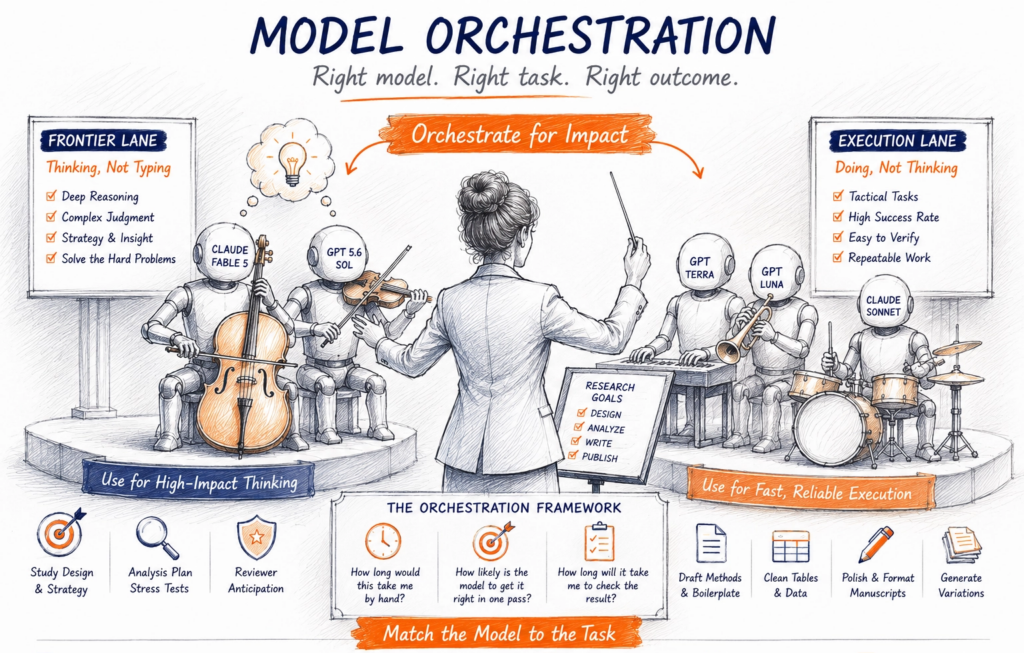
The most useful rule I’ve adopted is to separate the thinking from the doing. Run your frontier model only on frontier-worthy work. Hand everything else to something cheaper. In practice, that splits your AI work into two clean lanes.
The frontier lane is for thinking, not typing. Study design. Analysis plan stress-tests. The internal logic of a grant aim. Finding the holes a reviewer will find before the reviewer does. Planning a manuscript section by section. This is where Fable 5 or GPT 5.6 Sol earns its price.
The execution lane is for the tedious, checkable work. Reformatting references. Drafting boilerplate methods from a protocol you already wrote. Cleaning a table. Turning an approved plan into a first draft. Generating 5 versions of a paragraph so you can pick one. ChatGPT’s Terra, Luna, and Claude’s Sonnet do this fast and for a fraction of the cost, and you can verify the output at a glance.
Before you spend a single frontier credit, run a quick delegation test with 3 questions:
- How long would this take me by hand?
- How likely is the model to get it right in one pass?
- How long will it take me to check the result?
Tedious plus high success rate means delegate to the cheap model. High judgment plus a result you will rewrite anyway means keep it in the frontier lane and stay in the loop.
Five moves, translated to clinical research
Move 1. Ask the frontier model to find its own best work.
Start using Claude Cowork or ChatGPT Work.
For Claude, you can click on Cowork within the chat window.

And you will find “Work” at the top of ChatGPT.
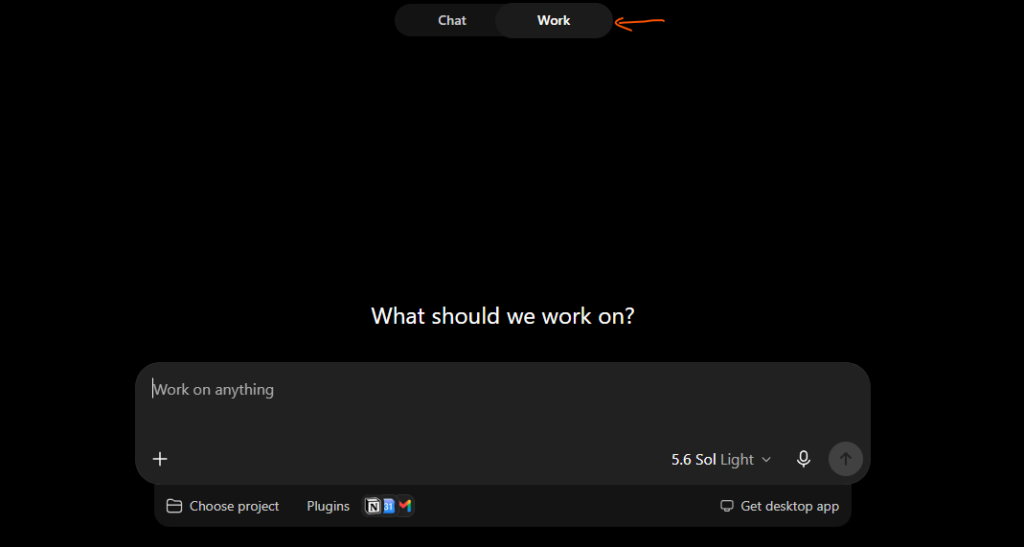
Point Fable or Sol at your project folder (project button right below the chat window) and your notes. Prompt it directly. “You are the most capable model I have access to. Read my aims, my analysis notes, and my draft. List the five tasks here that genuinely need deep reasoning and are worth your compute.” Then look at what it surfaces. It will not pick “format the bibliography.” It will pick the design flaw and the underpowered aim.
Move 2. Stress-test the study or the grant.
Give the frontier model your specific aims and your design, then tell it to argue like Reviewer 2. Where is the residual confounding. Where is the selection bias. Which aim is underpowered. This is centaur work, a clean line between what you do and what the machine does. You decide the science. The model pressure-tests it. In a controlled trial of 758 consultants, the people who used AI inside its strengths produced work graded more than 40 percent higher in quality, while those who leaned on it for tasks beyond its reach did worse than colleagues using no AI at all. Knowing which is which is the whole game.
Move 3. Make the manuscript submission-ready.
Frontier models are unusually good at an adversarial read. Ask one to read a finished-looking draft cover to cover and flag unsupported claims, numbers in the text that do not match the tables, and the exact sentences a reviewer will pounce on. These models now catch defects a quick review misses, the same way they surface real bugs in code that looked done. A cheaper model rarely catches this. A frontier model does.
Move 4. Plan the next study so a cheaper model can build it.
Ask the frontier model for a detailed protocol or statistical analysis plan from your raw inputs. Phases, decisions, risks, open questions, written clearly enough that a simpler model can execute it step by step. Then hand that plan to Terra, Luna, or Sonnet to draft the pieces. You planned with the expensive brain once and executed with cheap hands many times.
Move 5. Clean up your own system.
Your prompt library. Your analysis scripts. Your reference manager. The frontier model audits and finds the redundancies. The cheaper model makes the edits.
How to actually run it without burning your limits
Prep with the cheap model. Do not spend frontier credits loading a PDF or assembling a context document. Use Luna or Terra to gather and organize, then bring in Fable or Sol for the reasoning.
Give it a real brief. Good delegation documentation is the same thing as a protocol, a statistical analysis plan, or a product spec. What are we doing, why, what does done look like, and what should you check before you tell me you are finished.
My Persona(l) GOAL framework is the researcher’s version of exactly this. Persona, the role the model should adopt. Goal, the specific task. Output format. Lens of context, stuff that it needs to know about. Fill those four in and the model stops guessing.
Stay researcher-first. Never paste identifiable patient data into a public model. Turn off training on your data. Use a secure environment for anything sensitive. And check every citation the model hands you. A recent Nature analysis estimated that tens of thousands of 2025 papers may already carry invalid, AI-generated references.
The frontier model is a co-investigator, not the principal investigator. You own the science, the interpretation, and the accountability.
Babysit, and dial the effort down. Frontier models rabbit-hole and burn limits when you set them loose on maximum effort. Watch them work. High effort is not always the right setting.
The part that stung, then helped
When Fable rerouted my clinical questions to a weaker model without asking, I was frustrated for about a day. Then I stopped treating any single model as the whole answer.
I built a workflow that survives a model getting blocked, gated, or price-hiked next week. Because one of them always will.
And one more thing, because it matters more than the horse race. This scramble between Anthropic and OpenAI is good for us. More capable models, arriving faster, at lower prices, is exactly what an overworked researcher wants. We will have to watch how Fable holds up as the new ChatGPT models roll out, and I suspect the pricing and access rules will keep shifting for months. But capability without care is not progress. Competition should push these labs to keep safety a first-order feature, not a patch they bolt on after a government makes them.
Now the good news: You already know how to do this. You run a research program. You do not run every assay with your own hands. You scope the question, assign the work to the right person, and check what comes back. Managing a bench of AI models is the same job you already do. The scarce skill now is not typing. It is knowing what good looks like and describing it clearly enough that someone, or something, can deliver it. That skill is yours.
Pick one task on your desk this week. Split it into thinking and doing. Put the thinking in your frontier model and the doing in a cheaper one.
Notice two things. How much faster you move. And how little the next model release rattles you.
Top Papers on AI in research this week:
- Cheaper citation checkers – Verifying where a claim came from is slow, careful work. This benchmark asked whether small, inexpensive models can audit source attribution in deep-research pipelines. They kept pace with frontier models, so labs can fact-check citations without paying top dollar. Same idea as this post – match the task with the model.
- Safer clinical AI agents – Hospitals want automation they can actually trust. Researchers built CareConnect, an LLM agent that runs healthcare workflows like appointment scheduling inside firm safety limits. It finished 91.8% of those tasks while staying within its guardrails.
- Evidence-grounded medical reasoning – Clinicians need to follow the logic, not just read the verdict. FaithMed trains medical models to reason one step at a time against rubrics written by doctors. Scoring each step, rather than only the final answer, produced more accurate and more trustworthy decisions.
- Reasoning or just recall? – Chain-of-thought prompting can look a lot like real reasoning. IsoSci tested that idea with science problems built to share the same structure across different fields. It found that 91.3% of the reasoning-mode gains leaned on stored knowledge, not on genuine structural logic.
Top Papers on AI in education this week:
- Do models grasp teaching intent? – A good tutor senses when material means to teach rather than simply inform. This paper introduces the Adaptive Pedagogical Vigilance framework to probe that sense in LLMs. Guided by it, leading models tracked human judgments about pedagogical intent at a striking r=0.958.
- LLMs as math graders – Grading stacks of exams drains a teacher’s week. The authors measured how dependably language models score handwritten math answers. A gentler rubric cut grading errors sharply, because strict prompts kept punishing valid partial work.
- Beyond catching cheaters – Policing AI use with detection tools is a losing battle. The Universidad Politécnica de Madrid makes the case for redesigning assessments and writing clear usage rules instead. Its framework spans six dimensions and treats AI as a driver of student autonomy.
- Which questions can AI grade? – Not every exam item belongs in a machine’s hands. This study graded Linux and bash coding exams using a four-level difficulty taxonomy. Gemini 3.0 Pro matched expert scores on easy items, yet slipped as the questions grew harder.