

So much news in a week.
And no, I am not talking about affairs, or the end of the world, or IPOs, or bubbles. This newsletter is not a tabloid. I only care about how to use AI in the most effective and ethical way for academic research.
We will stick to our usual and in this post we will discuss 10 levels of AI adoption.
👋🏽 Quick announcement: Research Boost 3.0 is launching on Black Friday. It is the most agentic version of AI academic writing that we have built. Try it here: https://researchboost.com/
Three things to know before you find yourself on it.
- Higher is not better. The right level depends on how much you trust the AI to do the task without you, and how costly a miss would be. A cover letter and a primary analysis do not belong at the same level.
- Most clinical researchers get the most value from Levels 1 to 4 today. Levels 5 to 8 need technical help. Levels 9 and 10 are experimental and expensive.
- Two rules hold at every level. Identifiable patient data stays inside the systems your institution has approved. And you verify every claim and citation yourself before it enters your paper or proposal.
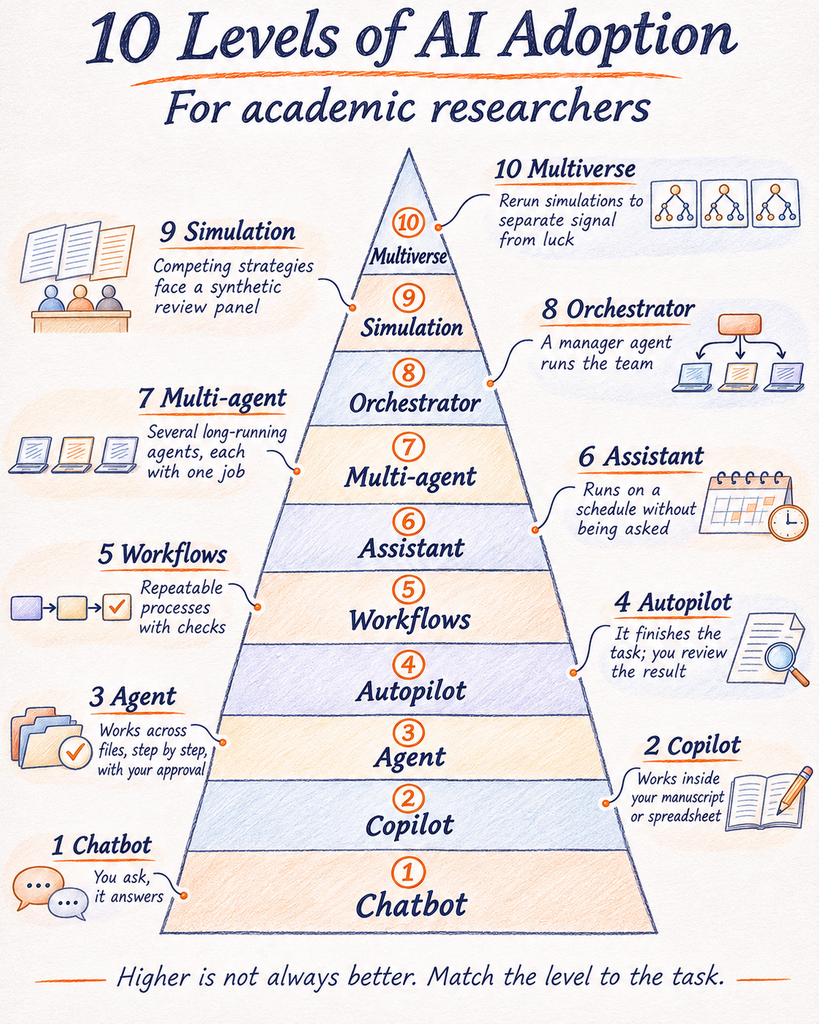
1. Chatbot: you ask, it answers
What it is: ChatGPT, Claude, or Gemini in a browser tab, with no access to your files or systems. You give it a task and it responds.
What changes: You stop starting from a blank page. A capable generalist is available at 11 p.m. when your co-authors are not.
Use it for: Turning rough notes into a first draft, summarizing a paper you upload, or pressure-testing a response to reviewers.
Try it:
I am uploading my collaborator comments on my manuscript and my rough notes on how I plan to respond. Draft a point-by-point response in a respectful, confident tone. Before you write, list every comment where my notes do not fully answer the comments, or where I would need new data or a new analysis.
Your judgment: Confirm every statement about your study. Open every reference. In one analysis of ChatGPT citations, 18% of the references GPT-4 produced were fabricated. I found that this number is lower for the newer models. While the citations themselves are not completely hallucinated (you get the right citation when you click on the link), the author, the journal, the publication year, or some aspect of it still is.
When to move up: This is where I started, building custom GPTs for my mentees and students. They helped. Juggling several of them did not. If you get real value from chat but spend your day copying and pasting between the chat window and Word, look at the next level.
2. Copilot: the AI works inside your file
What it is: The model sits inside the tool where the work already lives. Think Claude in Excel, Copilot in Word, or Gemini in Google Docs. It can see the whole document or spreadsheet without you pasting anything.
What changes: AI stops being a separate tab. It extends, revises, and interprets the work in place.
Use it for: Continuing a Discussion section in your own voice, cleaning a data dictionary, or reworking a grant budget.
Try it (in Excel):
This sheet is my five-year grant budget. Update personnel effort with the new percentages I list below and apply a 3% annual salary escalation. Flag any year where direct costs exceed $250,000, and add a summary row with the five-year total.
Your judgment: Check the formula behind every total. Then decide what to cut in the years that run over. That decision is yours.
When to move up: A copilot reliably sees one file. Research rarely lives in one file. When you need to pull from the analysis output, the manuscript, and the supplement at once, you need an agent.
3. Agent: it works across your files and checks in
What it is: You describe a task and the agent completes it step by step, asking for approval along the way. It can read a folder, operate apps on your computer, and compile information from several sources. It is reactive. It does nothing until you tell it to start.
What changes: AI becomes an operator that can carry a multi-step task under your supervision.
Use it for: Updating a manuscript after the analysis changes, or building an enrollment dashboard from a de-identified export.
Try it:
This folder holds the final analysis output from our statistician and the current manuscript draft. Update every number in the Results text and in Tables 1 to 3 to match the new output. Show me each proposed change beside the old value before you apply it. Flag anything in the output that looks inconsistent, such as denominators that do not add up.
Your judgment: Approve each change and check that the interpretation still follows from the numbers. Before an agent touches a folder, classify what is in it. I sort research data into four tiers: public, institutional, restricted, and critical. Only the tiers your institution permits go near the tool.
When to move up: The loop here is step, review, refine, repeat. When that review slows you down on low-stakes work, consider handing over the whole task.
4. Autopilot: it finishes the task and you review the result
What it is: You skip the step-by-step approvals (turning on auto-approve on ChatGPT and Claude). You describe what you want, let it run, and judge what comes back. You are often building something other people will use.
Which tasks qualify changes with every model release. Today I would hand over a lab website this way. I would not hand over a Specific Aims page. The argument is the work, and fixing a generic one takes longer than writing my own.
What changes: You review the end product instead of each step.
Use it for: A lab website, a custom sample size calculator for your team, or a first-pass poster layout.
Try it:
Build a one-page website for my research lab. Include our mission, current studies, team, a publications list, and a contact form for prospective trainees. Keep it clean and readable on a phone. Use placeholder text wherever you lack information, and list every placeholder at the end.
Your judgment: Read every word, test it on your phone, and check your institution’s branding rules before you publish. Anything that faces patients, such as a recruitment page, goes to your IRB first.
When to move up: Autopilot is fast and uneven. That is acceptable for a prototype. For higher-stakes work, you want structure around the agent.
5. Workflows: you build a repeatable process with checks
What it is: The agent no longer gets one shot. It plans, you review the plan, it implements, and it runs verification checks before you see the result. Your standards are written into the process.
This level needs technical judgment. For most clinical researchers it means analysis code, with your biostatistician or data analyst in the loop. It is also part of the design logic behind Research Boost, where a manuscript moves section by section and citations are checked against real literature at each step.
What changes: A written process, with your standards in it, lets you trust the agent with work you would otherwise do by hand.
Use it for: Sensitivity analyses, reproducible analysis pipelines, and reporting-guideline checks before submission.
Try it:
Before writing any code, read the statistical analysis plan and the existing scripts in this repository. Propose a plan for a sensitivity analysis that excludes participants with less than 12 months of follow-up. List the files you will change, the edge cases such as missing covariates, and how you will verify the result. Verification must include reproducing the current Table 2 first. Wait for my approval before you implement anything.
When it finishes, ask it to review the change the way a skeptical biostatistician would, rate its confidence from 1 to 100, and name the weakest parts.
Your judgment: Improve the plan before any code runs. Then decide whether the confidence score is earned. If you spot a problem it missed, name it and send it back.
When to move up: Even the best workflow waits for you to start it. For some tasks, that wait is the bottleneck.
6. Assistant: it runs without being asked
What it is: An assistant acts on a schedule or a trigger. It monitors a domain, does recurring work, and brings you what matters.
A Claude skill searches for new papers relevant to my current research and emails me 5 to 10 of them every Sunday. That email is surveillance. I still decide what to read. And when I start a new project, I still run the keyword search and the AI semantic search myself.
What changes: AI moves from reactive help to ongoing support.
Use it for: Literature surveillance, funding announcements, and deadline tracking. Start with public information. Connecting an assistant to institutional systems takes IT and compliance support, and your risk tolerance matters more here than at any earlier level.
Try it:
Every Sunday at 7 a.m., search PubMed and the preprint servers for papers on [your topic] from the past seven days. Send me the 5 to 10 most relevant, each with a two-line note on why it matters to my current projects. Every Monday, check for new NIH funding opportunities in my area and list any that are due within 90 days.
Your judgment: You still read the papers. Refine the rules when the brief misses something you later find on your own.
When to move up: One assistant can hold only so much context. When you want it to do more without crowding its memory, give the new job to a second agent.
7. Multi-agent: several long-running agents, each with one job
What it is: You manage more than one long-running agent at once. Each has a role, its own tools, and its own memory. Your work starts to look like leading a small team. This is rare outside senior engineering.
What changes: Work runs in parallel instead of in a queue.
Use it for: Keeping literature surveillance separate from study operations, so the contexts never mix.
Try it: Your literature assistant keeps its job. You set up a second agent with a different one.
You are responsible for data quality in our cohort study. Each Friday, review the de-identified enrollment export. List missing required fields, out-of-range values, and visits that fall outside the protocol window. Draft a query list for the research coordinator and flag anything that needs my decision.
Your judgment: Review each agent’s output on a schedule, the way you would review a new coordinator’s work. Keep each job description narrow.
When to move up: You have so many agents that you lose track of which one owns what.
8. Orchestrator: a manager agent runs the team
What it is: A manager agent plans the work, delegates to other agents, tracks progress, and brings you a consolidated result. You set goals, constraints, and the threshold for what reaches your desk. Research Boost 3.0 is built on this architecture (launching this Black Friday – please stay tuned :), where each manuscript section (for example, introduction, discussion) is a separate sub-agent, which is orchestrated by a coordinator or supervisor to generate the full manuscript or grant proposal.
The best published example in our world is the Virtual Lab from Stanford. A principal investigator agent led a team of scientist agents and a critic agent through research meetings. The team designed 92 nanobodies against recent SARS-CoV-2 variants, and two showed improved binding in the wet lab. The human researchers contributed about 1% of the words in those meetings. They also chose the question and ran every validation experiment.
What changes: You stop managing individual agents and manage the thresholds instead.
Use it for: Projects where you are the bottleneck, such as the search and screening stages of a scoping review.
Try it:
You lead this scoping review. Break the question into parallel searches by database and by concept. Assign one agent to each search, one to screen titles and abstracts against the attached inclusion criteria, and one to extract data into the attached template. Escalate only borderline inclusion decisions, disagreements between agents, and studies you cannot retrieve in full text. Report the counts at each stage in PRISMA format.
Your judgment: You own every inclusion decision. Audit a random sample of the exclusions yourself, and tighten the escalation rules if too much or too little reaches you. Human in the loop is still important and a core skill is to know when and what to check or do yourself. In Research Boost, this accountability is built in at each step, where each of the subagents asks you for important input about your study whenever required.
When to move up: Once agents can plan and execute, the harder question is which plan deserves the effort.
9. Simulation: competing strategies face a synthetic panel
What it is: Several teams pursue the same goal with different strategies. The strong ones survive and the weak ones are dropped.
Science already has a working version. Google DeepMind’s Co-Scientist, published in Nature in May, generates hypotheses, ranks them in an Elo-rated tournament of simulated scientific debates, and refines the winners. Drug repurposing candidates it proposed for leukemia held up in cell assays.
A good competition needs diverse judges, which means synthetic people. The evidence is early and mixed. Agents built from two-hour interviews with 1,052 real people matched their survey answers 85% as accurately as those people matched themselves two weeks later. In NEJM AI, comments from GPT-4 overlapped with a human reviewer’s about as often as two human reviewers overlapped with each other, roughly 31% against 29% for Nature-family papers.
What changes: Your job becomes designing the test that finds the best plan: the goal, the scoring, and the rules of the competition.
Use it for: Choosing among framings of your Specific Aims, among designs for a pilot study, or among recruitment messages.
Try it:
Here are three versions of my Specific Aims page, each built on a different central hypothesis. Set up a panel of five reviewer personas: a clinical trialist, a biostatistician, a basic scientist outside my field, a patient-oriented outcomes researcher, and a skeptical senior reviewer who has seen this idea fail before. Have each persona score every version on importance of the research and on rigor and feasibility, following NIH’s published review criteria, and write a short critique. Let the two lower-scoring versions revise in response. Run three rounds. Give me the winning version, what changed in each round, and the criticisms no version resolved.
Your judgment: The aims must be your ideas. NIH states that applications substantially developed by AI will not be treated as the applicant’s original work. Use the panel to stress test your thinking. Then take the surviving version and the unresolved criticisms to your real mentors (who cannot be replaced). A persona just shows what a reviewer might say.
The limits:
- Every team needs reliable orchestration, and three teams need three times your attention and many more tokens.
- Simulated reviewers are weak predictors of real scores so far. In a preprint covering 2,267 UK grant applications, the best LLM setup correlated only 0.26 with average reviewer scores.
- A panel trained on past success may reward the safe idea. In a PNAS study, proposals with heavier LLM involvement were less distinctive from funded work.
- Use only your own drafts. When you serve as a reviewer, NIH bars generative AI for analyzing applications, and uploading someone else’s application is unethical and breaches confidentiality.
10. Multiverse: rerun the simulation to separate signal from luck
What it is: You run the same simulation many times from the same starting point. Level 9 is one competition. Level 10 asks what wins on average.
A 2006 experiment in Science shows why this matters. Researchers placed 14,341 people into eight parallel worlds with the same 48 unknown songs. Where listeners could see what others had downloaded, the same song could lead one world and sink in another. The best songs rarely failed and the worst rarely won. Everything in between was open.
If you have written an NIH grant, that pattern is familiar. In a PNAS replication of NIH review, 43 reviewers scored 25 real applications and showed no agreement on quality. Who reviewed an application mattered more to its score than what it proposed. In Australia, an analysis of 2,705 NHMRC proposals found that 9% were always funded and 61% never were. The remaining 29% moved in and out of funding depending on which panel members scored them.
Most of our proposals will lie in that middle band. So one simulated review, like one real summary statement, tells you less than it seems to.
What changes: You stop treating any single run as the answer.
Use it for: High-stakes decisions that depend on how people react to each other, such as a resubmission strategy.
Try it:
Run the simulated review of my final Specific Aims page 50 times. In each run, draw three reviewers at random from a pool of 15 personas and vary the order in which they speak during discussion. Report how often the application lands in the top third, the range of scores, and every weakness that appears in more than half of the runs. Flag any strength that only one persona noticed.
Your judgment: Read the output as a robustness check. A weakness that shows up in 35 of 50 runs is yours to fix before submission. A strength that only one persona noticed belongs in your first paragraph.
It cannot forecast your payline. No published evidence shows that a simulated study section predicts real funding. If the personas are off, 50 runs give you a very confident wrong answer. The real study section is still the test.
(Fair warning: this is going to eat up your AI tokens fast and hit your limits.)
What the levels measure
There is no value judgment in these levels. Most researchers should not pursue orchestration or simulation yet, because the models are not reliable enough for most of what we do. A level that is out of reach this year may be routine after the next model release, so it is worth looking again.
We already know how to make this call. In competency-based medical education we make entrustment decisions. A fellow earns unsupervised practice one task at a time, after we have watched closely enough to trust the result. Give your agents the same treatment. Supervise closely, check the output, and extend autonomy to one task when it has earned it.
You wrote the research question, the aims, and the interpretation. AI at any level should give you more time for those.
Hit reply and tell me which level you work at most, and which single task you would move up one level this month.
Top Papers on AI in research this week:
- AI Peer Reviews Beat Human Reviews – A Harvard working paper by Gary King and Steven Worthington compared Claude Opus 4.8 reviews with 134 paid human reviews of 124 manuscripts. GPT-5.5 judged the pairs and preferred the AI review in all 132 decided cases. Three former journal editors chose the AI review in 26 of 30 judgments. The paper is not peer reviewed, and the human reviews came from a pre-submission coaching service.
- LLM Reveals Why LDL Goals Go Untreated – Stanford researchers used a GPT-5 based model to read clinical notes from 28,113 patients with atherosclerotic cardiovascular disease (JAMA Cardiology). The model classified medication changes with an F1 of 0.98. It classified reasons for not intensifying therapy with an F1 of 0.80. Notes that recorded an LDL goal strategy led to intensification 21.9% of the time, versus 7.1% without one.
- Six LLMs Tested on Asthma in Pregnancy – Researchers asked six consumer chatbots 19 patient questions, and three clinicians rated the 114 answers. GPT-5.5 and Claude Sonnet 5 scored highest on overall quality. About one third of responses (32.5%) carried a safety concern, and four were rated high risk. No model reached an eighth grade reading level. The authors do not support unsupervised patient use.
- Human Checks for AI-Produced Research – The authors propose a human-in-the-loop framework for checking AI-generated research, prompted by Open AI releasing more than 700 AI-generated math manuscripts in October. The authors argue that a passing check certifies only the artifact that was checked. Their framework has 4 parts: validated tools, a fidelity audit, fixed human decision points, and a report crediting human and AI work.
Top Papers on AI in education this week:
- Stanford Evidence Review of AI in K-12 – Stanford’s SCALE Initiative updated its review on November 10, covering trials from October 2025 through June 2026. Strong causal studies rose from 20 to 52. Results were mixed. AI helped more when it supported learning than when it replaced student thinking. A GPT-4o tutor raised unassisted scores by 0.15 SD among 770 Taiwanese students. Gemini Guided Learning raised math scores by 0.258 SD in Sierra Leone.
- What Makes an LLM a Tutor? – This survey reviewed LLM-based and agentic tutoring systems, drawing on work from late 2022 to mid 2026. It breaks tutoring into architecture, learner modeling, interaction, orchestration, and evaluation. The authors argue that fluent answers alone do not make a tutor.
- Claude Code as an Exam Grader – A computer graphics instructor had Claude Code grade 60 handwritten mid-terms. Totals correlated 0.97 with the expert, with a mean error of 0.85 marks out of 20. The AI leaned 0.68 marks generous. Drawing items were the weakest area. The author says it is not ready to replace instructor judgment on borderline cases. This is one course with one expert benchmark.