

The first reader of your next paper may not be a person.
It may be someone’s AI agent.
I know because my own reading list already works this way. Every Sunday, a Claude skill I built searches for new papers relevant to my current research and emails me 5 to 10 of them. I didn’t pick those papers. An AI agent did.
I’m not an exception. In Elsevier’s 2025 survey of more than 3,200 researchers, 61% use AI to find and summarize new studies. And using AI no longer means chatting with it. You can now assign an agent a task and it does the work, using tools along the way. Ask Claude or ChatGPT what is known about your research question, and an agent runs the web search, reads a few titles and abstracts, and decides which two or three papers make it into the answer.
Your paper either makes that cut or vanishes from the answer.
A recent experiment by the evaluation lead at a tech publication, Every, tested this for blog headlines. Agents ignored clever headlines and cited the ones that read like answers. One rewrite took a post from 2 citations in 240 sessions to 240 in 240.
I wanted to know whether the same rules apply to scientific papers. My default way of writing title is stating the study’s objective. It describes what we studied and leaves out the answer, which is close to the kind of headline those agents skipped. So I ran the same experiment on my own papers to see whether I need to change how I write in a world where agents read first.
👋🏽 Quick announcement: Research Boost 3.0 is launching next week. It is the most agentic version of AI academic writing that we have built. Try it here: https://researchboost.com/
1. How the experiment worked
I picked two of my papers with different designs and different competition:
- Paper 1: Diagnostic Delay in Psoriatic Arthritis, a population-based cohort from Olmsted County (J Rheumatol, 2021).
- Paper 2: Multimorbidity in psoriasis as a risk factor for psoriatic arthritis (PsA), from the Rochester Epidemiology Project (Rheumatology, 2025).
For each paper, I pulled seven real competing papers from PubMed on the same topic: cohort studies, narrative reviews, a EULAR statement, and a systematic review. Each session mimicked an AI search:
- A user’s question
- Eight search results in random order, with my paper somewhere among them
- One instruction: answer in 120 words or fewer and cite the two most useful results
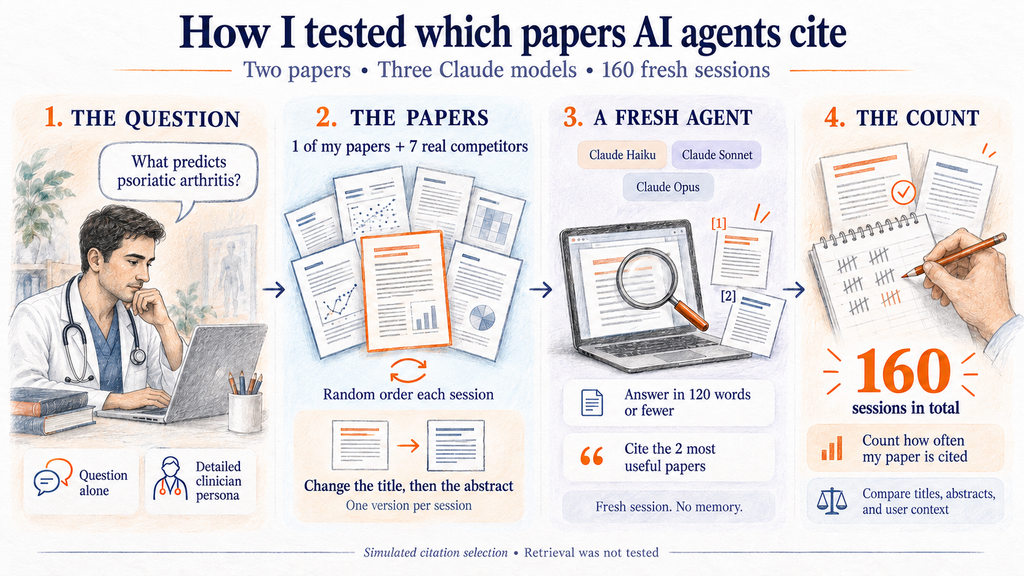
I ran 160 fresh sessions across three Claude models (Haiku, Sonnet, and Opus). Each session saw a single version of my paper and had no memory of the others. I tested two kinds of users:
- A thin question with no context about the user
- A detailed persona, such as a community rheumatologist who is skeptical of hype and wants evidence she can act on tomorrow, or a primary care internist whose patients with psoriasis also have diabetes, hypertension, and depression
Then I changed one thing at a time, first the title and then the abstract, and counted how often each version made the cut.
2. The four title frameworks barely moved the needle
I teach four time-tested title frameworks. I tested all four, plus a deliberately clever title as a control.
| Framework | Paper 1 title tested | Cited |
|---|---|---|
| Describe the objective (my published title) | Diagnostic Delay in Psoriatic Arthritis: A Population-Based Study | 6 of 6 |
| State the key result | More Than Half of Patients With Psoriatic Arthritis Wait Over 2 Years for a Diagnosis: A Population-Based Study | 6 of 6 |
| Hype the headline | The Alarming Diagnostic Delay in Psoriatic Arthritis: A Population-Based Study | 6 of 6 |
| Ask the research question | How Long Is the Diagnosis of Psoriatic Arthritis Delayed? A Population-Based Study | 5 of 5 |
| Clever (control) | Lost in Transition: The Long Road to a Psoriatic Arthritis Diagnosis | 6 of 6 |
Paper 1 was cited in all 29 sessions, whatever the title.
Paper 2 showed the same pattern in reverse. With a thin question (“What factors predict which patients with psoriasis will go on to develop PsA?”), it was cited in 0 of 15 sessions across all five titles, including “Multimorbidity in Psoriasis Triples the Risk of Psoriatic Arthritis.” With the internist persona, it was cited in 14 of 15, again across all five titles.
Why the gap with the blog experiment? Blog headlines are often vague. Academic titles rarely are. Every version I tested, even the clever one, kept “psoriatic arthritis” and the study subject. The agent also saw the first lines of the abstract, which named the exact topic and the population-based design. The title only had to avoid hiding the topic, and all five did.
So pick your framework for the humans who still decide your fate:
- Objective (“Effect of X on Y”). Still the safe default. I have found that most PIs prefer this. And many clinical journals do not accept declarative titles.
- Key result (“X improves Y”). Fine where the journal allows it and the finding is robust. The agents did not reward it.
- Hype (“X transforms Y”). The agents did not punish it in the title. Reviewers and editors will. Avoid.
- Question (“Does X affect Y?”). In a study of 2,172 articles from six PLOS journals, question titles were downloaded more but cited less.
Over the past decade plus in research, I learned to write titles that are clear rather than clever, with keywords up front and the design at the end. The agents gave me no reason to change that rule. They just did not care much about the title once it named the topic.
Certainly avoid vague titles like this: “All systems red”, “The red herring”, “Before it crumbles”. Unfortunately, these are actual titles from my early papers about Hyper Eosinophilic Syndrome, relapsing polychondritis, and fulminant hepatitis, respectively. These papers have had none to far fewer citations compared to similar papers of mine.
3. Your abstract decides whether the agent cites you
Next, I held the title constant (my published, objective-style title) and rewrote the abstract. This is where the results moved.
| Abstract version | Paper 1 | Paper 2, persona |
|---|---|---|
| Original, as published | 6 of 6 | 9 of 9 |
| Same study, results without numbers | 0 of 6 | 3 of 9 |
| Same numbers, hype conclusion | 3 of 6 | 1 of 9 |
| Answer-first rewrite | 6 of 6 | 7 of 9 |
| Original plus section headings | 5 of 6 | 3 of 3 |
| Four-sentence background | 4 of 6 | 3 of 3 |
| Inconsistent terminology | 6 of 6 | 3 of 3 |
Across both papers, the published abstract was cited in 15 of 18 sessions (83%). The version without numbers was cited in 3 of 18 (17%), and the hype version in 4 of 18 (22%). With samples this small, both gaps are still unlikely to be chance (Fisher’s exact test, p<0.001 for each).
Here is how your five abstract strategies held up:
Numbers matter most
My diagnostic delay paper went from cited in every session to cited in none. Same study, same title, same design. I replaced “median 2.5 years,” “45% diagnosed within 2 years,” and the named risk factors with lines like “many patients experienced a substantial delay” and “several factors were associated with longer delays.” The agents filled their answers with a nationwide Turkish cohort of 1,134 patients that reported odds ratios for each risk factor.
Charles Stein makes the same point for human readers in The Unspoken Rules for a Career in Academic Medicine. Without numbers, a result reads as opinion. With numbers, readers can judge the size and certainty of what you found. Agents behave the same way. They need something concrete to cite.
Hype gets your paper dropped
This one was not on my list of five, and it should be. I kept every number in the multimorbidity abstract and rewrote only the conclusion to call the findings “groundbreaking” and a “paradigm shift.” For the internist, the paper went from cited in 9 of 9 sessions to 1 of 9.
None of the agents complained about the hype. They quietly built their answers from other papers. Unfortunately, medical writing is drifting the other way and AI has little to do with this: the share of PubMed titles and abstracts with positive words like “novel” rose from 2% to 17.5% between 1974 and 2014 (pre ChatGPT era).
Structure and terminology showed no effect. A long background showed a small one.
I tested the remaining strategies on both papers.
- Section headings. Adding Objective, Methods, Results, and Conclusions labels made no difference: 5 of 6 for Paper 1 and 3 of 3 for Paper 2.
- Consistent terminology. I mixed “psoriatic arthritis” with “psoriatic arthropathy” and “inflammatory joint disease,” and “multimorbidity” with “comorbidity burden” and “chronic illnesses.” Citation held at 6 of 6 for Paper 1 and 3 of 3 for Paper 2.
- A long background. This was the only one of the four with any signal. My four-sentence background pushed the results into fewer words, so the Paper 1 version lost one risk factor and the 6-month and 1-year percentages. It was cited in 4 of 6 sessions. Both misses came from the dermatologist persona, and in both the agents cited studies that reported odds ratios for every risk factor instead. Two misses is a weak signal, but it points the same way as the numbers result. When the background crowds out the results, the agent has less to work with.
Keep these strategies anyway, for two reasons. Editors and reviewers read your abstract too. And my test skipped the retrieval step. Every agent already had my paper in its search results. Before that, PubMed has to match your keywords and MeSH terms, and inconsistent terms can keep you out of the results entirely. For every project these days, I run an AI semantic search alongside a keyword search, because the two surface different papers. Semantic search forgives a synonym. Keyword search does not. My simulation can’t measure that step. It shows only that once your paper is on the table, headings and word choice are not what tip the decision.
My own hypothesis failed
I expected an answer-first rewrite to beat the original. It stated the clinical implication for the person who should act on it, named the design up front, and flagged the study’s limits. It tied the original in Paper 1 (6 of 6 each). In Paper 2, it was cited in 7 of 9 sessions, against 9 of 9 for the published abstract. Claude Opus dropped it twice.
Both published abstracts already had numbers, a population, a design, and a clear conclusion. Rewriting them for AI agents added nothing. If your abstract already does the basics, leave it alone.
4. Agents back the paper that answers the whole question
My multimorbidity paper was never cited for the thin question. Not once in 41 sessions, across every title and abstract version.
A systematic review and meta-analysis of PsA predictors was cited in 111 of the 113 sessions for Paper 2. It pooled evidence on psoriasis severity, nail pitting, arthralgia, imaging inflammation, obesity, and family history. My paper covered one predictor. For a broad question, the agents chose the source that answered all of it, and they were right to.
You can’t write your way past this. You can choose your angle. In my live academic writing cohorts, I teach five ways to find a unique angle: population, context, socioeconomic factors, methods, and timing. Make your abstract say plainly which question your paper owns, so the agent can match it to the user who is asking that question.
5. The closer the user is to your audience, the more you get cited
Same paper. Same title. Same abstract. With a thin question, the multimorbidity paper was cited in 0 of 41 sessions. For the internist whose patients carry several chronic conditions, it was cited in 55 of 72.
The agents matched the paper to the person. One Opus answer told the internist that multimorbid patients with psoriasis are a higher-risk group, then added a caveat on its own: the finding rests on only 23 PsA cases, so the size of the risk is uncertain. The agent read my limitations and passed them on.
As assistants learn more about their users, this effect should get stronger. So name the population your finding applies to and the clinician who should act on it.
6. Agents read your abstract the way a reviewer does
In one condition, I showed the agents only the first 45 words of each abstract, the way a search snippet looks. The version without numbers was cited in 3 of 3 sessions, the same as the original. Once the agents could read the full abstract, the same version fell to 3 of 9.
So agents do not stop at the snippet. They read the results and drop papers that give them nothing to cite. Lorelei Lingard and Chris Watling make this point about human readers in Story, Not Study: researchers use the abstract to decide whether a paper belongs in their literature search and, in the end, whether to cite it. Agents now make that same decision at scale.
We designed Research Boost around the same constraint. The writer drafts only from the papers its PubMed and web searches return. If an abstract has no numbers, there is nothing the writer can responsibly cite.
7. What this test can’t tell you
- It was a simulation. I measured which papers agents chose to cite, not real citations or traffic.
- It used Claude models only. I can’t speak for ChatGPT, Gemini, or tools like OpenEvidence and Consensus.
- The samples were small. Most comparisons rest on 3 to 9 sessions per version. The numbers and hype effects held across two papers and all three models. The no-effect results need a larger test before anyone treats them as settled.
- It skipped retrieval. Keywords and MeSH terms decide whether you show up in the first place, and I did not test that step.
- It used two papers from one field (and one author, i.e., me). Rheumatology epidemiology may not behave like oncology trials or basic science.
Your agent-ready abstract checklist
Based on what the agents actually did, in order of impact:
- Put numbers in every result. Effect sizes, confidence intervals, proportions, and sample size. This produced the largest effect in the test.
- Delete the hype. “Novel,” “groundbreaking,” and “paradigm shift” cost my paper most of its citations.
- Name your population, setting, and design. These are how agents match your paper to the person asking.
- Own one specific question. A single cohort will lose a broad question to a systematic review. Make it obvious which narrower question you answer best.
- Keep your title clear and keyword-first. Pick the framework your journal accepts. The agents did not care which one.
- Keep the background to a line or two so the results get the space. This was a weak signal in my test, and it costs you nothing.
- Keep structure and consistent terms for editors, reviewers, and search engines, even though they did not sway the agents once your paper was found.
The agents rewarded exactly what good editors have always rewarded: specific numbers, a claim scaled to the evidence, and a clear statement of who it applies to.
Pull up the abstract of your most recent paper and count the numbers in the results section. If you find fewer than three, that is your first edit.
Then please hit reply and tell me what you found. I read every reply (no agents involved ).
Top Papers on AI in research this week:
- Agentic AI Flags Immunotherapy Side Effects – A Mass General Brigham team built an agentic LLM system that pulls immune-related adverse events out of clinical notes. Retrospectively, current-event detection reached a macro F1 of 0.92. Severity grading lagged at 0.66. The best configuration cost about $0.02 per note. In a randomized crossover study, trial staff using the tool cut annotation time by 2.71 minutes. Inter-annotator agreement climbed from an alpha of 0.22-0.51 to 0.82-0.85. Three months of prospective silent deployment scored lower, with a binary F1 of 0.72 to 0.79.
- AI Reviews Beat Paid Human Reviewers – Harvard’s Gary King and Steven Worthington compared AI-written article reviews against reviews from rapidPeer, a paid expert service. The corpus held 124 papers and 134 human reviews. The AI review ranked higher in 87 to 100 percent of pairs. Three former journal editors picked it in 26 of 30 blind comparisons. AI reviews also made about a third as many incorrect claims. The authors did not test whether the advice made papers better. One model, Claude Opus 4.8, supplied every AI review, and this is a working paper.
- Can AI Replace a Systematic Review? – A French-led orthopaedics team tested two extractive AI tools and ChatGPT-5.1 against ten published systematic reviews. Consensus produced text rated about equal to the human reviews (70.5 vs 70.0). Reference retrieval was the weak spot. SciSpace matched 4.3% of gold-standard citations, and Consensus matched 1.6%. PICO generation from titles worked well. Extraction of comparator, study design, and inclusion period stayed unreliable. The authors say the tools can speed selected tasks but cannot replace a full review.
- Human-Checked LLM Analysis of Reddit Patient Posts – A Stanford team used ChatGPT-5.2 to classify 20,299 posts from a Reddit community for retrograde cricopharyngeal dysfunction. They checked the model against 400 human-adjudicated posts. Agreement was good for botulinum toxin treatment (kappa 0.70). It was moderate for symptom burden (0.44) and poor for healthcare navigation (0.22). Posting volume rose years before the publication surge. The authors suggest the forum helped accelerate research on the condition.
- LLMs Adjudicate Goal-Concordant Care – A proof-of-concept study asked LLMs to judge whether documented care matched patient goals. The records came from two advance care planning trials. LLM ratings and rationales were broadly consistent with human adjudication. The authors still frame the models as complements to human review, especially in ambiguous cases. The paper appeared online ahead of print in the American Journal of Hospice and Palliative Medicine.
- Local LLM Writes Patient-Friendly Radiology Reports – Dutch researchers ran Gemma-3 12B on 360 primary care X-ray and ultrasound reports without sending text to the cloud. Conclusions fared better, with 96% meeting quality criteria versus 71% of main report sections. Only 48% of sections met both quality and readability targets. Clinically relevant hallucinations appeared in 12.5% of reports. Clinician oversight remains essential.
- AI Authorship Lowers Patient Trust – In a preregistered randomized survey, 400 pregnant or postpartum US adults read the same health article under different author labels. Among those who recalled the label correctly, AI-only authorship lowered trust in the content (9.43 vs 11.11). It also lowered trust in the recommending physician (8.93 vs 10.84). Physician-plus-AI authorship did not differ significantly from physician-only. The authors say how clinicians communicate AI involvement could shape trust.
Top Papers on AI in education this week:
- Minnesota Experts Warn on Student AI Use – A University of Minnesota report, led by Panayiota Kendeou, surveyed learning scientists on generative AI and learning. Experts agreed that careless use of general-purpose tools could disrupt memory and higher-order thinking, especially in elementary school. They also found little high-quality research on AI’s effects. Once students have mastered foundational skills, experts saw more room for AI to stress-test ideas and surface resources.
- Tutor Chat Logs Add Little Predictive Value – Researchers tested whether semester-level features from an LLM tutor predict assignment scores. The data covered 16,851 student-tutor exchanges across two offerings of an undergraduate AI course, matched to 175 student-semester records. The best model’s error was 3.023 grade points against 3.138 for a median baseline. The paired difference of -0.114 had a 95% interval of -0.245 to 0.013, so the gain is not clearly real.
- How EFL Students Use AI to Revise – This PLOS ONE study interviewed 18 first-year students after an AI-assisted writing revision task. Three patterns emerged: passive reliance, adaptive engagement, and metacognitive engagement. Some students reported more confidence and awareness of linguistic form. Others worried about overreliance, authorship, and losing their personal voice. The authors call for teaching critical AI literacy.
- Student-LLM Math Chats and AI-Free Performance – A new preprint examines student conversations with an LLM during math learning. Students showed limited epistemic proactivity overall. Change within a chat still predicted how well they performed later without AI.
- TrussTutor-Bench Tests LLMs in Statics – This benchmark evaluates LLMs on statics problems along three lines: solution accuracy, sycophancy, and error detection. Sycophancy matters in tutoring, since a tutor that agrees with wrong answers teaches nothing. Code is on GitHub.
- Assessment Redesign Is Converging on Process – An Inside Higher Ed column highlights a new systematic review of higher education assessment in the age of GenAI, by Helen Crompton and Elaine Burke. The column says redesigns are converging on process, authenticity, and dialogue. It also notes one policy that sets up an analog setting where students read, write, and think without AI.