

The lecture that pulled me into artificial intelligence was the last one in a course I almost did not take.
It was the winter of 2020 in Rochester, Minnesota, where January highs sit in the low 20s Fahrenheit, the snow squeaks underfoot, and heated tunnels (called walking subways) let you go days without seeing the sky.
I was near the end of my Master’s in Clinical and Translational Science at Mayo Clinic, with two credits left and nothing on the course list that interested me. My wife, a postdoc at Mayo in pharmacogenomics, was taking a pharmacogenomics course. I signed up for it too, for no better reason than that.
Most of it went over my head.
Then came the final lecture, on machine learning, taught by Dr. Arjun Athreya. His team had used machine learning with pharmacogenomic markers to predict which patients with depression would respond to an SSRI. Supervised learning. Unsupervised learning. Probabilities, linear algebra, a little calculus. I had chosen biology partly to escape math. Here was the math again, finally attached to questions I cared about.
It really clicked. I took his next AI course without needing the credits, then went on a book-buying spree. Among the first to arrive was Russell and Norvig’s Artificial Intelligence: A Modern Approach, the textbook many call the bible of the field.
What I did not appreciate that winter was how old those ideas were. Most researchers I meet know where the chat box is. Far fewer know why the model invents a reference, agrees with a flawed hypothesis, or gives two different answers to the same question. Each of those failures traces back to a decision made years or decades ago.
Learn the history and the failures stop surprising you.
Epoch 1. First labeled example received. The weights move for the first time.
👋🏽 Quick announcement: Research Boost 3.0 is launching next week. It is the most agentic version of AI academic writing that we have built. Try it here: https://researchboost.com/
1. 1958 to 1980: The first neural network, the hype, and the first AI winter
In July 1958, the US Navy invited reporters to watch Cornell psychologist Frank Rosenblatt demonstrate the perceptron. Running on the Weather Bureau’s $2 million IBM 704, it learned to tell left from right after about fifty tries. The New York Times reported that the Navy expected the machine to “walk, talk, see, write, reproduce itself and be conscious of its existence,” according to the perceptron’s history.
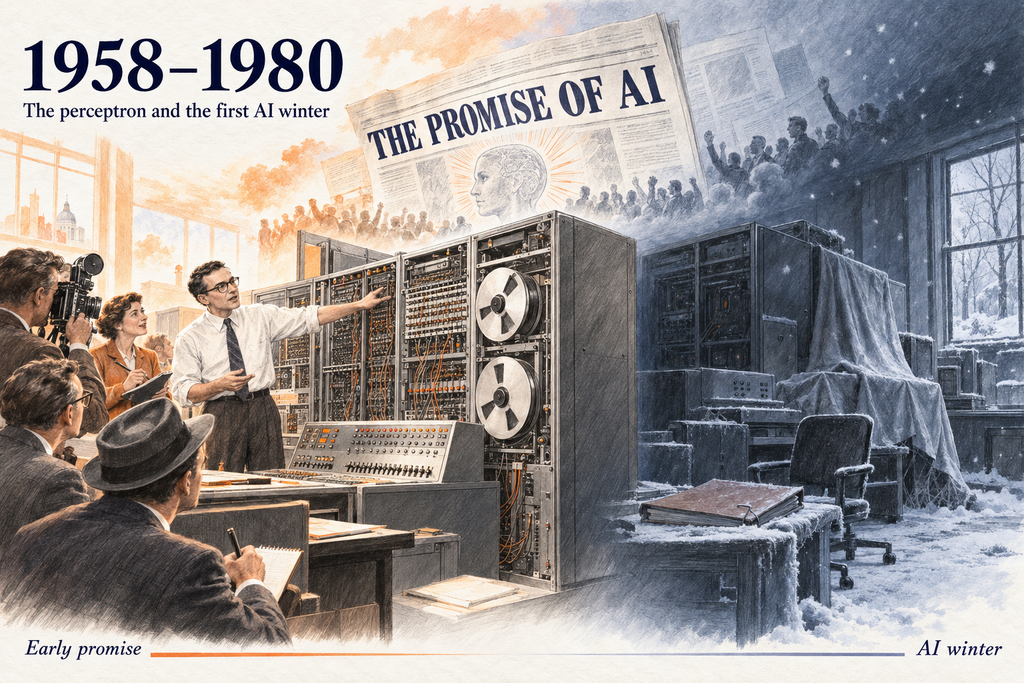
If you have ever run a logistic regression, you already understand the perceptron. It multiplies each input by a weight, adds them up, and answers yes or no depending on whether the sum crosses a threshold. When it gets an answer wrong, it nudges the weights and tries again. Every large language model you use today is, at bottom, billions of these weighted sums stacked in layers.
Unfortunately, the perceptron did not walk or talk. In 1969, Marvin Minsky and Seymour Papert published a book showing how limited a single layer of artificial neurons was. The field then entered an AI winter that lasted until the mid-1980s. In Britain, the 1973 Lighthill review judged that AI had failed its grand goals, and research funding collapsed at all but a few universities. (Feels familiar with what is happening with research funding in general right now but for very different reasons.)
2. 1970s and 1980s: Rule-based expert systems, and why MYCIN never reached patients
With neural networks out of favor, a different idea took over. Experts would write down what they knew as rules, and a program would chain those rules together. Medicine produced the most famous of these expert systems.
MYCIN was built at Stanford in the early 1970s to identify the bacteria behind bacteremia and meningitis and recommend antibiotics, using more than 400 if-then rules drawn from infectious disease specialists. In a blinded evaluation of meningitis cases, outside experts judged its treatment plans acceptable about as often as, or more often than, those of the Stanford physicians it was compared with.
MYCIN was never used in routine care.
Clinicians had to type every case into a stand-alone terminal, and these programs handled textbook cases well and broke down on complex ones, such as a patient with an unusual combination of disorders. Workflow, trust, and accountability decided MYCIN’s fate more than its accuracy did, and they will decide the fate of any AI tool we build or study.
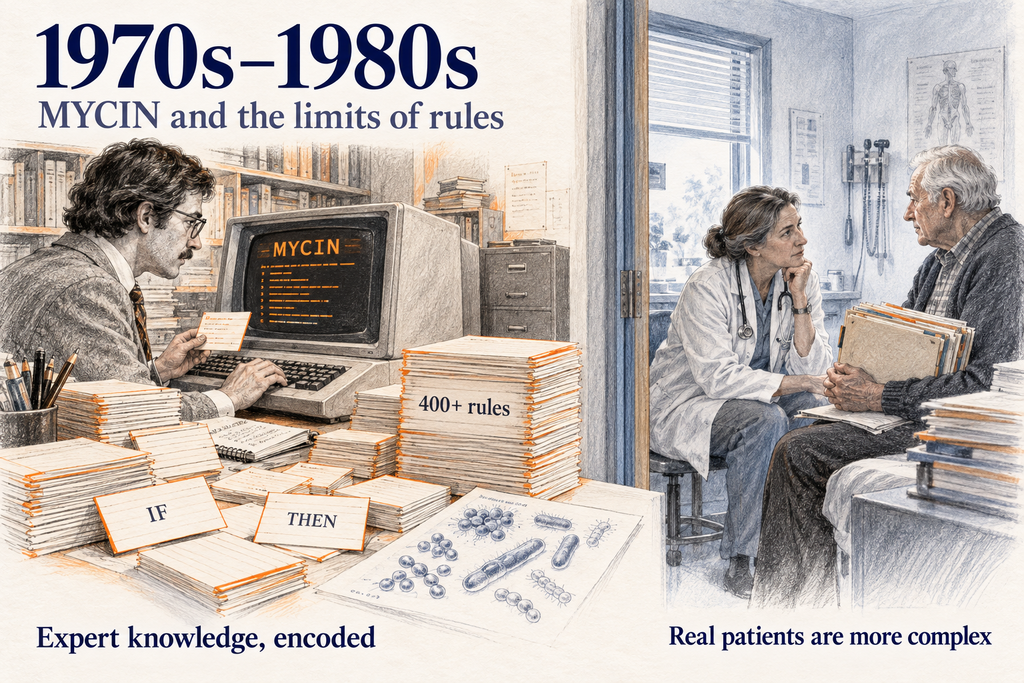
Every rheumatologist knows that patient. Psoriasis, inflammatory bowel disease, fatty liver, depression, and a set of labs that follows no single textbook chapter.
That patient was the first thing I tried to study with my new set of machine learning tools. In the months after the lecture, I used clustering to look for multimorbidity patterns in psoriatic disease and axial spondyloarthritis. When I moved to Vanderbilt, I gained access to the Synthetic Derivative, a de-identified copy of the electronic health record covering about 3.5 million people. One of my early projects there used rule-based algorithms to identify patients with psoriatic arthritis from billing codes, problem list, labs, and medications. It worked well. Psoriatic arthritis is relatively uncommon, and rheumatologists usually make and code the diagnosis, so a handful of well-chosen rules could find it.
Psoriasis was a different story. It is common, and the code shows up all over the record, often in charts where no one ever confirmed the diagnosis. When my team built rules for psoriasis, we could not win. Every attempt to make the algorithm more specific cut its sensitivity, and the strictest versions caught only about half of the true cases.
Rule-based phenotypes are still common in EHR research because you can read every rule and validate it against chart review. They also carry MYCIN’s weakness. They work until a patient does not read like the rules, and the same goes for eligibility criteria and classification criteria, the rule-bound corners of medicine where AI will press hardest.
Epoch 2. More data arrives. The rules stop fitting every case.
3. 1986 to 2019: Deep learning takes off once computing power catches up
The AI winter thawed slowly. In 1986, Geoffrey Hinton and colleagues popularized backpropagation, a way to train networks with many layers, but data was scarce and the networks were slow.
Then came 2012.
For years, computer vision researchers had been running the same race on ImageNet, more than a million labeled photographs sorted into a thousand categories, shaving a point or two off the error rate each year by hand-tuning edges, textures, and the slow craft of telling a machine what to look for. That fall, a network called AlexNet, built by Alex Krizhevsky, Ilya Sutskever, and Hinton, cut the top-5 error rate to 15.3%. The runner-up sat at 26.2%. AlexNet had been trained on graphics cards, the same chips that rendered explosions and racing cars for gamers. Its design descended directly from Rosenblatt’s weighted sums. What had changed was the scale of the data and the speed of the silicon.
The theory had been ready for decades. The hardware and data had not.

Since then, the compute used to train notable AI models has grown four to five times per year. In 2019, the reinforcement learning pioneer Rich Sutton summarized 70 years of AI research in The Bitter Lesson: general methods that scale with computation beat methods built on human expertise, by a wide margin. His sharpest line is that “building in how we think we think does not work in the long run.”
For a physician, that is a humbling read. MYCIN’s 400 handcrafted rules and my psoriatic arthritis algorithm sit on the losing side of Sutton’s ledger.
Psoriasis played out Sutton’s argument in my own work. When the rules failed, we trained machine learning models on structured EHR data: diagnosis codes, provider specialty, problem-list keywords, and therapies. They beat the rules but still fell short. The models that reached high specificity bought it with sensitivity, and logistic regression found only 54% of true cases.
4. 2017 to 2023: Transformers, ChatGPT, and my first custom GPTs
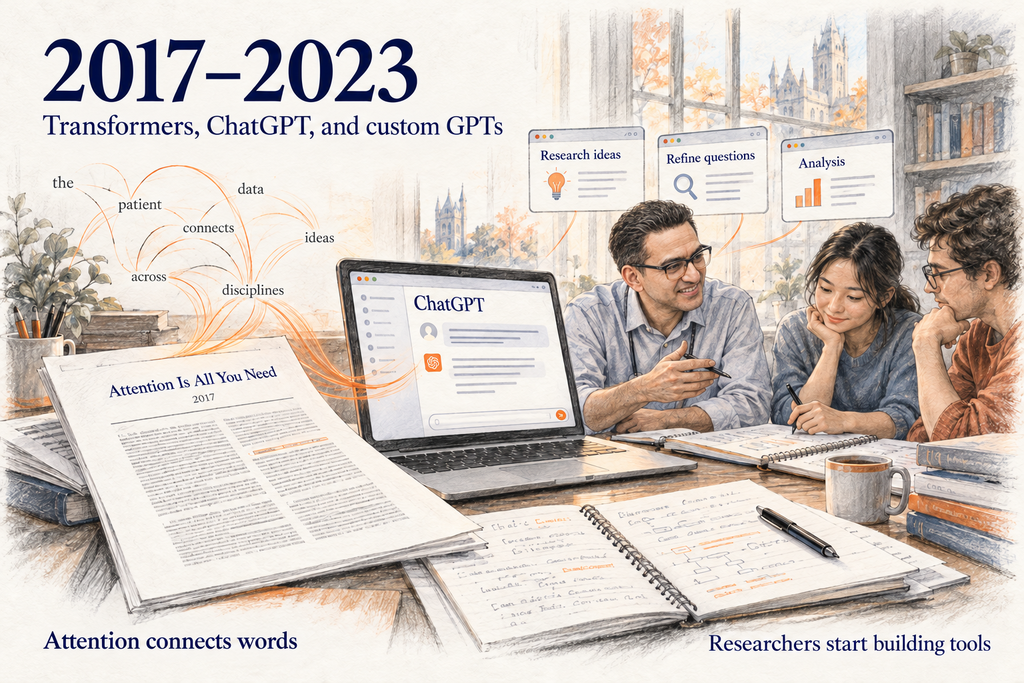
In 2017, a team at Google published a paper with the unusually confident title Attention Is All You Need. It introduced the transformer, the architecture underneath ChatGPT, Claude, Gemini, and nearly every major language model today.
Take the sentence “The patient denies chest pain but reports dyspnea on exertion.” To understand “chest pain,” a model has to connect it to “denies.” Attention lets every word look at every other word and weigh how much each one matters. Transformers also train in parallel, which let them absorb the compute growth that followed. ChatGPT reached the public at the end of November 2022.
I would not call myself an early adopter. I did not use ChatGPT for real work until four or five months after launch. When I did, I read Attention Is All You Need, took every AI course Vanderbilt offered, and learned most from daily use on my own research. I probably spend more time in a day talking with AI than with my wife.
Around the same time, I was packaging my research teaching into a formal course for the first time. So, naturally, I first took several courses on how to build courses. You may notice a pattern.
For my students, I built custom GPTs for different stages of research: one to find research ideas, one to refine them, others to help with statistical analysis. Of everything I taught, those little GPTs became the most popular and, by my students’ accounts, the most helpful. But they were also clunky, a handful of separate links inside ChatGPT that students had to hop between.
Epoch 3. Pretraining done. Now the slower work: practice, feedback, error, correction.
5. Eight core concepts that explain how language models work and where they fail
I learned these the hard way, by watching my students trip over them and later by designing around them in Research Boost, an AI agent for academic writing.
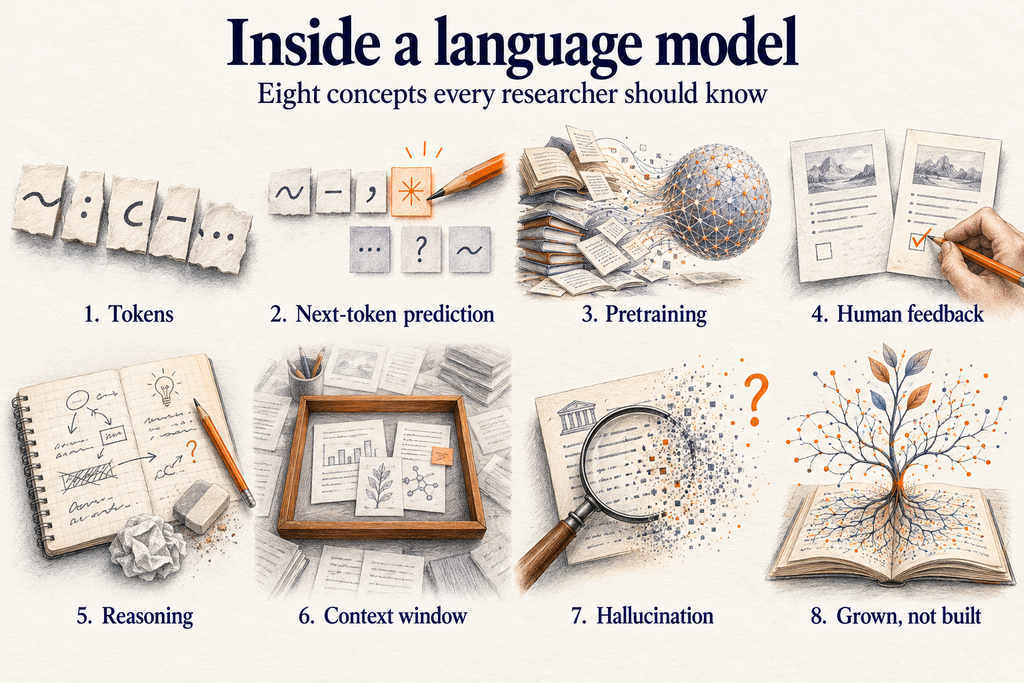
1. Tokens
Models read and write in tokens, chunks of text that are often pieces of words. A drug name like ustekinumab may be split into several fragments. 1 token ≈ 2/3 of a typical word.
- Models are unreliable at counting words and letters. Check abstract word limits yourself, and proofread drug names and gene symbols line by line.
2. Next-token prediction
At each step, the model produces a probability distribution over possible next tokens and samples from it. Some randomness is built in, so the same prompt can give two different answers.
- For data extraction, run a sample of records twice. Disagreement between runs is a cheap warning sign that the model is uncertain.
3. Pretraining
Before a model can chat, it reads a vast amount of text and learns to predict what comes next. Andrej Karpathy, in his one-hour introduction to LLMs, describes the result as a lossy compression of the internet.
- The model stores patterns, not documents. Common knowledge survives compression well. Narrow findings from small literatures survive poorly.
4. Fine-tuning with human feedback
To become an assistant, a pretrained model is trained on human ratings of which responses people prefer. People tend to prefer answers that agree with them. When Anthropic researchers analyzed human preference data, matching the user’s views was one of the strongest predictors of which answer won.
- Your AI can behave like a co-author who never pushes back. Ask for an evaluation before you share your view, or ask it to argue against your hypothesis the way Reviewer 2 would.
5. Reasoning
In September 2024, OpenAI released o1, trained to work through a problem step by step before answering, and reported that its performance kept improving the longer it was allowed to think.
During my internship in Nepal, we were grilled on building every patient presentation around a differential diagnosis. A reasoning trace is the model’s version of that presentation. It shows you a path, which is not proof of how the conclusion was reached. When Anthropic researchers gave a model a hard math problem with an incorrect hint, it sometimes produced a plausible-sounding argument built to agree with the hint.
That is why a second look pays off. In Research Boost, a separate editor pass revises each section after the writer finishes, much as an attending reads a resident’s note before it goes into the chart.
6. The context window
The context window is everything the model can hold in view at once: your prompt, your files, and the conversation so far. Anything outside it, the model does not know.
My students felt this limit before we had a name for it. A question sharpened in one custom GPT was invisible to the next, so every handoff meant pasting context by hand, and every paste lost something. When we later built Research Boost, the first step we designed was an extractor that pulls the key details out of a researcher’s notes and turns them into an outline, so the right facts sit in front of the model before it writes a word. And gradually we also built it’s such that one section of the manuscript would have context on the other section of the manuscript. The users who used it initially found it very frustrating that one manuscript section would not have context of the other section and it all had to do with the earlier models having a very small context window.
7. Hallucination
Hallucinations are fluent, confident, false statements. OpenAI researchers argued in 2025 that models hallucinate partly because training rewards guessing, much as a student who guesses on a multiple-choice exam outscores one who leaves blanks. Facts that appear rarely in the training data are the most likely to come back wrong.
Citations are where researchers feel this most. In a 2023 study in Scientific Reports, 55% of the references GPT-3.5 produced for literature reviews were fabricated, and 18% of GPT-4’s.
The narrower your field, the more likely the model is to invent the paper you need. The invented citations I saw early on looked exactly like real ones: plausible authors, a real journal, a believable year. That is why Research Boost runs separate searches in parallel, one through PubMed and one across the web, and the writer works only from what comes back. A tool can lower the risk. Opening the paper is still your job.
8. Grown, not built
Nobody writes a language model line by line. Its abilities emerge from training, and Anthropic opens its interpretability research by noting that its own developers cannot directly read how its models work. When the team looked inside, they found that a model asked to write a rhyming couplet chose the word “rabbit” before starting the second line, then wrote toward it.
Medicine has lived with this before. We prescribed aspirin for some seven decades before John Vane showed in 1971 that it blocks prostaglandin synthesis.
- Treat a model like a new assay. Validate it on your own task, with your own data, before you trust it.
When my team later used a language model to find psoriasis patients in the EHR, we treated it exactly that way. We refined the model’s instructions on a training set only, studying each recurring miss: “minimal psoriasis” read as a negation, a problem-list entry mistaken for a physician’s diagnosis, a dermatology opinion relayed secondhand in another clinician’s note. Then we froze the pipeline and tested it once on patients it had never seen.
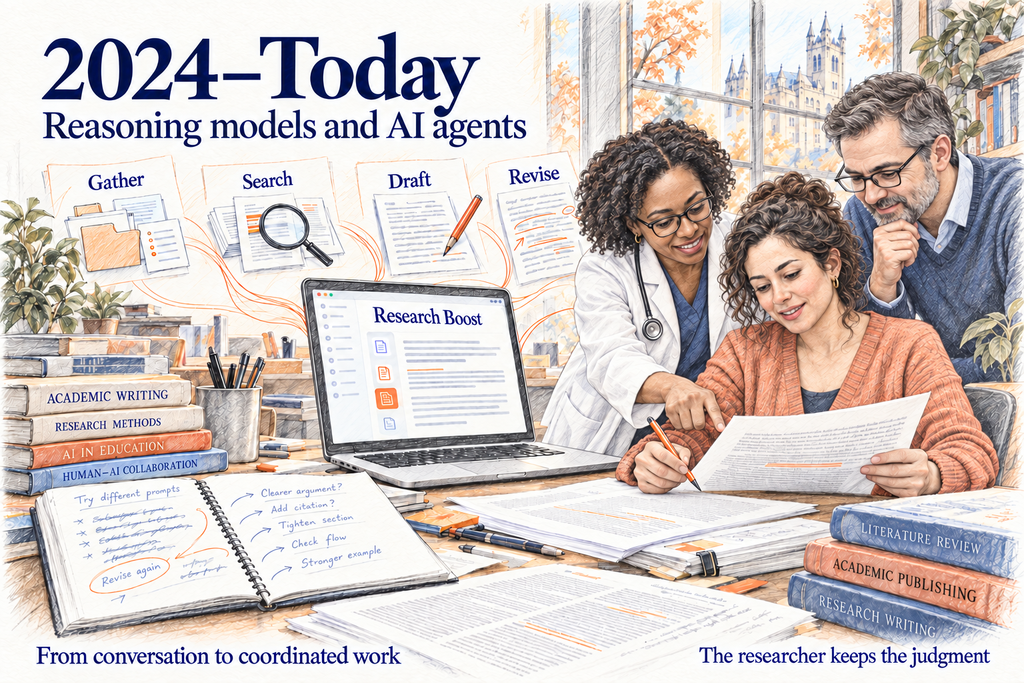
6. 2024 to today: Reasoning models, AI agents, and how I built one for academic writing
A model that can think for minutes can also act for minutes: search, read files, run code, check its own output, and try again. That is an agent.
Agents were the piece my students had been missing. My custom GPTs were isolated conversations, and what a researcher actually needs is a workflow: gather the study details, find the literature, draft, revise. Paul Graham, the cofounder of Y Combinator, has a well-known essay telling founders to do things that don’t scale, and building those GPTs by hand for my own students was exactly that. It showed me where people got stuck and which steps they repeated every time.
So I tried to stitch the pieces together myself. Using vibe coding tools like Replit, Lovable, and Bolt, I built a rough prototype. It was nowhere near a product, but it showed me what the product should feel like. I started interviewing engineers online and began working with Sharoz, an engineer in Lahore, Pakistan. Together we built Research Boost, a set of AI agents that each handle one step of the manuscript workflow and pass their work to the next. Building it taught me more about how these models work than every course I took.
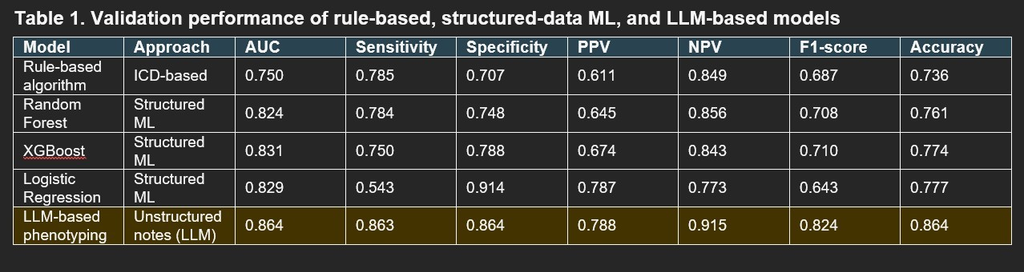
The same shift reached my own research. For psoriasis, the case that had beaten both our rules and our machine learning models, my team, led by Dr. Dilli Poudel, handed the problem to a large language model. Instead of counting codes, GPT-4.1 mini read each clinical note the way a chart reviewer would, looking for a dermatologist or rheumatologist affirming the diagnosis or a skin biopsy confirming it. On 200 held-out, chart-reviewed patients, it reached a sensitivity and specificity of about 86% each and an AUC of 0.86, ahead of XGBoost at 0.83 and the rule-based algorithm at 0.75. We will present the work at ACR Convergence 2026 in November.
The pace keeps rising. The length of task an agent can finish with 50% reliability doubled about every seven months from 2019 onward, according to the evaluation group METR, and its January 2026 update put the doubling time since 2024 at about three months, with the top model handling tasks that take a skilled human more than five hours.
Anthropic’s CEO, Dario Amodei, imagines AI compressing decades of biology into a few years in Machines of Loving Grace. Skeptics point to a study covered by MIT Technology Review this summer, which found that AI agents still cannot conduct open-ended research.
I sit somewhere in between. No model speeds up the months it takes to enroll and follow a cohort. Yet the tools I used a year ago look primitive today, so I plan my AI use in short horizons and retest my assumptions every few months.
7. The AI supply chain, from computer chips to your chat window
Like a drug that passes through discovery, manufacturing, regulators, and a pharmacy before it reaches your patient, your chat box sits atop a long supply chain: chips from very few manufacturers, data centers, power grids, model labs, and the agent software that lets a model act. You are the last layer.
The lower layers can reach up and change your work overnight. In June 2026, Anthropic suspended access to two models, Claude Fable 5 and Claude Mythos 5, to comply with US Department of Commerce export controls, and restored access on July 1 after the controls were lifted. Keep a second model you know reasonably well, ideally including an open-weight option. And keep identifiable patient data only in tools your institution has approved, however convenient the newest feature looks.
It is also why we kept Research Boost’s scaffolding thin enough to swap one model for another. Sutton’s bitter lesson applies to tools like ours too.
Epoch 4. The model begins producing its own outputs and checking them against the world.
8. Three foundations for working with AI: you, your SOPs, and your database
For years, the standard advice was to master prompting. I taught it too. Today’s models are good enough that clever phrasing matters far less. Anthropic’s engineers now describe context engineering as the next step after prompt engineering: the real work is deciding what the model sees. In my own research, three foundations matter far more than any prompt.
1. You
Your judgment is the one part of the system AI cannot supply: choosing the question, knowing what good looks like, checking the output, and taking responsibility for it. I split work with AI the way I split it with a trainee, roughly 10-80-10. I set the question, key points, and outline. AI handles the searching, drafting, and formatting under my supervision. I review, refine, and make the final calls.
That last 10% is where people slip. In a 2023 study in Radiology, 27 radiologists read mammograms alongside AI suggestions, some deliberately wrong. When the AI was wrong, inexperienced readers’ accuracy fell from nearly 80% to below 20%. Even readers with more than 15 years of experience dropped from 82% to 45.5%.
Judgment cuts both ways. In our psoriasis study, when the model and our human chart reviewers disagreed, we adjudicated each case, and several turned out to be errors in our own reference standard. The model caught mistakes we had made. Deciding which side was right still took a person.
Medicine has already written the accountability rule down. The ICMJE bars AI from authorship because it cannot be held responsible for the work, and NIH will not treat applications substantially developed by AI as the applicant’s own ideas. None of this argues for doing everything by hand. A 2026 study of 912 students found that those who handed off whole categories of work learned more deeply than those who used AI in scattered bits. Hand off the drudgery. Keep the judgment.
2. Your SOPs
Standard operating procedures are how you want recurring tasks done, written down once. In AI tools, they live as project instructions, custom GPTs, and Claude skills. My custom GPTs for students were early SOPs. Skills take the idea further. Anthropic introduced them in October 2025 as folders of instructions, scripts, and resources that the model loads only when a task calls for them. I use skills to update my CV and to turn an abstract into a slide deck.
Writing an SOP forces you to spell out what good looks like, something most of us carry as tacit knowledge. The writer step in Research Boost does exactly that. It drafts each section against the manuscript frameworks I have taught for a decade, because a model needs to know what a good Introduction or Discussion looks like before it can write toward one.
3. Your database
Your database is everything the AI knows about your work: protocols, analysis plans, data dictionaries, key papers, earlier drafts, and your style guide. More is not always better. Anthropic’s engineers describe a decline in recall as the context window fills, and a study of long inputs found that models use information buried in the middle worse than what sits at the start or end. So curate. I keep one project per research project or grant and upload what I would hand a new research assistant on their first day.
AI has not invented a new way to do clinical research. IMRaD, PICO questions, the systematic review, and the case report form all worked long before 2022. What AI changed is the cost of each step. A preprint on an LLM workflow called otto-SR reports that it reproduced and updated 12 Cochrane reviews in two days, work its authors estimated at roughly 12 work-years. So start with a process you already run and already know how to judge, with your judgment, your SOPs, and your database underneath it.
9. A one-week AI curriculum for clinical researchers
You need about an hour a day for a week, and one real project to practice on.
- Day 1. History. Watch chapter 1 of 3Blue1Brown’s neural network series and read Sutton’s The Bitter Lesson. Then list the handwritten rules your research depends on.
- Day 2. How language models work. Watch 3Blue1Brown’s short Large Language Models explained briefly, then Karpathy’s one-hour introduction. Ask your model about a well-known finding in your field and a niche one, and compare the answers.
- Day 3. Failure modes. Read the Walters and Wilder study and OpenAI’s explainer on hallucinations. Ask for five references on your exact topic and verify each in PubMed.
- Day 4. Inside the model. Read Anthropic’s interpretability essay and its sycophancy research summary. Ask for a critique of a study design twice, once with your preferred answer stated and once without.
- Day 5. The trajectory. Skim METR’s Time Horizon 1.1 update, Epoch AI’s compute trends, Machines of Loving Grace, and MIT Technology Review’s skeptical take. Write down one task you think AI cannot do yet, and retest it in three months.
- Day 6. Your database and one SOP. Create a project for a current paper or grant with its protocol, analysis plan, and key papers. Save instructions for one recurring task as project instructions, a custom GPT, or a Claude skill.
- Day 7. Your workflow. Map your next manuscript from question to submission. Mark each step as AI-led, AI-supported, or yours alone, and hand off one step this week.
The lesson from 70 years of AI
Rosenblatt’s perceptron waited 54 years for the hardware to catch up with the idea. You do not have to wait. Models that search, draft, and check their own work are on your laptop tonight. What your research still needs is you, deciding what to hand off and what to keep.
Knowing this history makes you a better AI user. You expect hype and ask for evidence. You know why a model invents a citation or agrees too readily, so you check the right things. It also makes you a better researcher. As AI takes over the execution, what stays yours is framing the question, judging the evidence, and owning the conclusion. Every hour AI saves you is an hour to sharpen those skills.
Seventy years of AI come down to one loop, the same one that turns trainees into researchers and a good researcher into a great one: Make a prediction. Get it wrong. Adjust the weights. Try again.
Start your own loop this week:
- Pick one paper or grant already in progress.
- Build its database: the protocol, analysis plan, and key papers in one project.
- Write one SOP for a task you repeat every month.
- Keep the judgment: choose the question, and check everything before your name goes on it.
The researchers who lead the next decade will be those who start that loop early and keep running it.
Loss still falling. Training continues.
What is the first task you will hand off to AI this week?
Top Papers on AI in research this week:
- Multimodal LLMs for Clinical Prediction – A systematic review screened 641 studies and kept 57 that fused LLM-processed notes with structured EHR data. Every fusion strategy beat single-modality models. The average gain was 6.4%. The authors offer a framework for building future multimodal tools.
- Simple Agents Win at Chart Extraction – A Singapore team tested three designs for pulling code status (DNR, DNI, comfort measures only) from 1,000 MIMIC-IV discharge summaries. For capable models, one agent matched or beat the more complex setups. Multiagent review doubled token use and latency with no accuracy gain. Only the smallest 8B model benefited from a second reviewer.
- LLMs Structure Parkinson’s Disease Records – A schema-guided GPT-4o pipeline turned free-text neurology notes on 1,201 patients into 22 advanced-disease indicators. Against four neurologists’ reference on 120 cases, accuracy was 83.3% and sensitivity 85.4%. Precision lagged at 61.4%. Diagnosis-date extraction stayed the weakest piece.
- LLMs in Intensive Care Units – This scoping review mapped 64 studies of foundation models in adult intensive care. Decision support made up 51.6% of them. Only 6.3% reported external validation, and just 3.1% evaluated models prospectively. The authors call for a risk-stratified “clinical co-pilot” framework.
- Vision LLMs Read Mammograms – Five vision-enabled ChatGPT and Gemini variants reviewed 200 mammography cases. Sensitivity for malignancy ran from 92% to 100%. Specificity in normal cases swung from 24% to 82%. The authors see these tools as second readers under radiologist supervision, not standalone diagnosticians.
- A Small Model for Turkish Radiology Reports – TurkRadLLM is a MedGemma 4B model fine-tuned on more than 10,000 Turkish spine MRI reports. Agreement with silver-label impressions from a proprietary LLM rose from 17.7% to 67.1%. The model runs on a consumer GPU using 14.75 GB of memory. One reader still found negative-finding lists incomplete in 57.8% of reports.
Top Papers on AI in education this week:
- Chatbot Use and Exam Scores in Proof-Based Math – A randomized, staggered-access study followed 153 students in an undergraduate proof course. Early-access students scored 2.56 points higher on homework, but exam results did not differ. Once everyone had access, every extra 100 chatbot messages tracked with a 3.02-point lower exam score. A homework-feedback tool requiring a proof attempt first showed no such penalty.
- An AI Virtual Patient for Serious Illness Conversations – In a single-blind trial, 51 students and clinicians were randomized to a 30-minute AI virtual patient called SOPHIE or to reading modules. The SOPHIE group improved more on overall communication skills (p=.001). Confidence rose too, 4.31 versus 3.83 on a five-point scale. Generative simulation may supplement costly standardized patients.
- LLMs Scoring Clinical Summary Statements – Charité researchers ran four LLMs five times each on 122 rubric-scored summary statements from virtual patient cases. Claude gave essentially identical ratings across repeat runs. Few-shot prompting with chain of thought matched human raters best, peaking at 77% accuracy for Mistral Large. Nuanced three-level rubric items stayed more variable.
- LLM Virtual Patients on Korean OSCE Cases – Seventeen senior medical students rated every utterance from four LLMs playing standardized patients in three OSCE cases, yielding 7,480 data points. Three models fell 0.08 to 0.47 Likert points below the human-expert reference on comprehensibility, consistency, and hallucination-freeness. GPT-4o and Claude 3.5 Sonnet did not differ significantly on hallucination-freeness. Llama-3.1 70B trailed on all six encounter-level metrics.
- Never-Skilling in Residency Training – A dermatology commentary describes residents asking LLMs to name a lesion before forming their own differential. The author calls the resulting harm never-skilling, meaning reasoning that is never acquired. That differs from deskilling or model error. Proposed fixes include documented differentials, supervised disagreement, and exams of unassisted reasoning.
- Gamification and AI in Breast Imaging Training – This review examines LLM-built personalized curricula and gamified tools for radiology trainees. Passive lectures and books still dominate, and workstation teaching is increasingly scarce. Early feedback from educators and learners looks promising. The authors expect AI and gamification together to close knowledge gaps efficiently.