

Last year, a very senior researcher gave me advice I still think about. NIH now caps a PI at six grant applications a year. “You’ve got 6 golden tickets,” they told me. “Use every one.”
It sounded generous. It is one of the worst pieces of advice I have ever received. And in the age of AI, a lot of researchers are about to take a version of it without realizing.
There’s a belief spreading through academic circles right now, and I think it is quietly going to hurt careers. The belief is that AI rewrote the rules of research, and the people who win from here will be the ones who prompt the most, generate the most, and submit the most.
I build AI tools for researchers, I use these tools every day, and I am telling you that belief aims your effort at the wrong target.
Let me walk through what actually changed, and what didn’t.
⏰ Before that, a quick reminder – I’m running 2 FREE live webinars this weekend with limited remaining seats:
- For grant writing with AI masterclass (Sat July 25, 10 AM CDT), register here: https://risingresearcheracademy.easywebinar.live/event-registration-13
- For manuscript writing with AI masterclass (Sun July 26, 10 AM CDT), register here: https://risingresearcheracademy.easywebinar.live/event-registration-14
1. What leverage actually is
Leverage is the gap between what you put in and what you get out. High leverage means a small input produces a large output. Low leverage means you grind for a small return.
AI is high leverage. That part is real, and I am not here to talk you out of it. But AI is NOT the only lever in research, and this is exactly where people get lost. They start behaving as if AI has replaced every existing piece of leverage in research, and they let the others go slack.
2. The real leverage in research has not moved an inch
Every source of leverage that built research careers before AI still builds them now. If anything, they matter more, because everyone else is distracted:
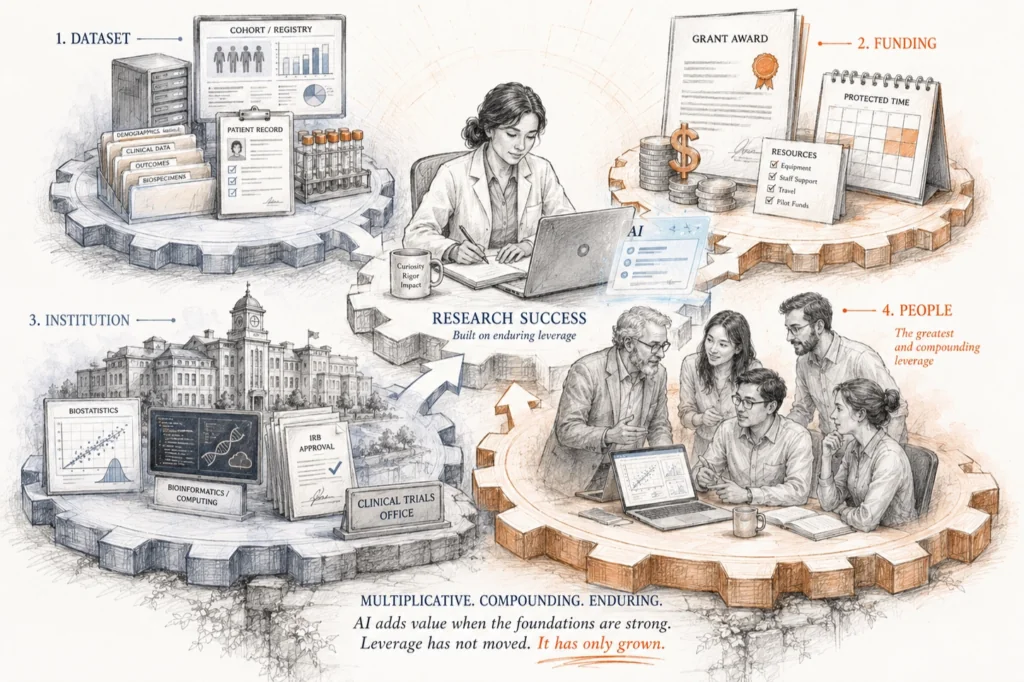
- Your dataset is still leverage. A well-phenotyped cohort, a registry, a biobank, a clean longitudinal dataset you have access to. That is a moat AI did not build and cannot replace.
- Money is still leverage. A funded R01, a foundation award, a philanthropic gift, protected time bought with a K award. Funding lets you hire, run assays, buy out clinical time, and take the long shots. AI arriving did not erase a dollar of that.
- Institutional resources are still leverage. Your biostatistics core, your bioinformatics group, your clinical trials office, your IRB support, your department chair who protects your time. These are advantages you cannot download.
- Your people are your biggest leverage of all. Mentors, collaborators, the people in your lab. The genetics collaborator who knows why your proposed method won’t work. The senior mentor who has already walked the path you are standing on. The postdoc who catches the flaw in your analysis at midnight.
Here is the part most people miss: these forms of leverage are multiplicative. A great dataset alone is nice. A great dataset plus the right collaborator plus protected time plus a mentor who has sat on the study section you are applying to is a different universe. They compound. AI stacks on top of all of it, but it multiplies zero into zero if the other levers are empty.
People are still the biggest leverage. That has not changed. AI does not cancel it.
3. Yes, AI made grant writing easier. That is precisely the trap.
It is much easier now to draft an aim, structure a proposal, tighten a specific aims page, and get an application out the door. So the temptation is obvious. If writing a grant is cheaper, faster, write more grants.
But what actually happens when your capacity goes up? You start doing things you would never have bothered with before, because now you can.
But the things you would not have bothered with were low priority for a reason. AI does not make them high priority.
AI just lets you do unimportant work faster, and faster unimportant work is still unimportant work.
Not having AI used to force a discipline on us. It forced you to prioritize, because you only had so many hours and you were not going to waste them on a proposal you half believed in. Take that constraint away and a lot of people fill the space with volume.
Now put those 6 golden tickets back in the picture. NIH already decided for you that you cannot spray and pray. Could I submit 6 grants a year? Sure. Would they be quality grants? Not a chance. If I pour myself into one or two big applications that actually move the science forward, or move my career forward, that is worth far more than 6 rushed ones every single time.
4. The moat is deciding, and AI cannot decide for you
The highest-leverage thing you can do in a research career is not generating more. It is making good decisions about where to point your very limited attention.
Think about what a single good decision does. When I look at a line of work and conclude it is not worth pursuing right now, I just freed up months of my own time and my team’s time. It is far more valuable to correctly decide something is not a priority than to automate that same non-priority beautifully. One of those advances your career. The other produces polished, irrelevant output.
AI cannot make that call for you. It does not know your field’s politics, your career stage, where the science is actually heading, or what a study section will care about eighteen months from now. Choosing the one thing that deserves your next six months is the highest-skill move you make, and it is yours alone. That is the moat.
I learned this the slow way. I started as an international medical graduate with zero publications and a research process that was, honestly, haphazard and tedious. I generated a lot of activity and not much traction. I initially took any and every research project that came my way. But things only started to click once I started to focus. The lesson that stuck was not “do more.” It was “decide better, then execute hard on the thing you chose.”
5. What this looked like on my own desk this month
I recently submitted a grant to the Arthritis Foundation, and it made this whole argument concrete for me.
I had run the proposal through AI several times before it went anywhere. It genuinely helped. It tightened language, caught gaps, and structured sections faster than I could alone. But then I handed the same draft to my mentors for thirty minutes, and that thirty minutes was worth more than every AI pass combined. Not ten percent more. An order of magnitude more.
My mentor told me the grant had all the right pieces but needed to be simplified. That is the kind of judgment only an expert who has lived in the field can offer.
When NIH studied grant-writing coaching for early-career investigators, the coached group reached a 22 percent R01 success rate, above the overall rate for new R01 awards. A mentor who tells you the hard truth is one of the highest-return relationships in your career.
The methods told the same story. I can ask AI for methods all day, and it will give me competent, plausible text. It is no match for sitting down with my genetics and statistics collaborators and confirming that what I am actually proposing holds up against how the data behaves in the real world. That conversation is not a formality. It is the difference between a method that survives review and one that gets torn apart.
6. So where does AI actually belong?
Use it. I do, aggressively, and I saw its promise early enough to build tools around it. I also saw the peril early: hallucinated facts, invented citations, black-box writing that quietly risks your credibility. Those risks are not abstract. One analysis found fabricated references in published papers rose roughly sixfold in two years as these tools spread. NIH saw the same danger and now states that applications substantially developed by AI will not be considered, because they are not the applicant’s original ideas. That is exactly why I treat AI as an amplifier for the researcher, not a replacement for the judgment.
Held that way, AI is a phenomenal research assistant. It drafts, it structures, it accelerates, and it is awake at 11pm when no one else is around to read your aims.
It gives the real superheroes, the researchers, a genuine superpower.
What it does not do is decide which fight is worth having, or tell you the hard truth your mentor will.
So ask yourself honestly. “Has AI made you a better researcher, or just a busier one?” If it is the second one, the tool is not the problem. Where you are pointing it is. Aim it at execution, and keep the deciding, the people, and the mentors who will tell you the truth close.
That is the leverage that was always going to win.
Top Papers on AI in research this week:
- Can LLMs Form a Real Hypothesis? – Chinese Academy of Sciences and Alibaba benchmarked 15 frontier models on generating hypotheses from incomplete evidence. Structured prompting helped weaker models but degraded some of the strongest.
- AI’s Hidden Cost to Science – A UW and Princeton model finds LLMs raise the opportunity cost of a researcher’s time, which can push people to polish papers less, not more.
- LLMs Meet Drug Design – Insilico Medicine’s new 3D-Fit benchmark shows LLMs can juggle multiple spatial constraints but still trail specialized drug-discovery tools.
- Mapping Biomedical Knowledge on a Budget – Open University fine-tuned sub-9B models to lift biomedical relation classification by 34 F1 points, making cheap ontology-building practical.
Top Papers on AI in education this week:
- Police or Guide? AI Rules in CS Classrooms – CS instructors mostly write policies that protect assignments over learning, and the defensive fixes strain teacher-student trust.
- Learning to Learn With AI – Hands-on practice with generative AI beat lectures for building metacognitive awareness, with gains holding at five weeks.
- What Does a Degree Still Prove? – An audit of 30 universities argues allow-or-ban labels fail, and schools should define what students may delegate versus demonstrate.
- Culture Shapes What Counts as Cheating – Given identical rules, Canadian students judged AI use in coding far more harshly than Korean students.