

Every week I see the same advice recycled across LinkedIn.
“Stop overcomplicating your prompts.”
“Let the AI do its thing.”
“Just give it the goal and get out of the way.”
The advice is well meaning, backed by science, and for most people, correct.
IBM ran 430,738 evaluations across 8 prompting techniques. The famous “let’s think step by step” instruction lost to just asking the question normally with a brief role description. Researchers from EPFL, Apple, and Mistral found that few-shot examples actually sabotaged modern AI models. Remove the examples, state the goal, and accuracy jumped nearly 10 points.
Modern AI models are capable enough that over-specifying the path often makes the output worse, not better.
So why am I telling you the opposite?
Because you are NOT “most people.” You are a clinical researcher.
And the tasks that define your career, manuscript writing, grant drafting, peer review responses, statistical reasoning, sit in a category where average AI output is not just unhelpful. It is dangerous.
👋🏽 Quick announcement: I would love to have you in my 5-Week LIVE AI Academic Writing Accelerator (included with Research Boost subscription) • Starts September • Limited to 100 Seats → Reserve Your Seat HERE
When the Destination Is Not on the Map
There are 2 things you can be specific about when prompting AI: the steps you want taken (the PROCESS) and the result you are trying to reach (the OUTCOME). For most tasks, being specific about the outcome and letting AI figure out the process is the better move.
But when the task requires deep domain expertise, you need both.
I grew up in Nepal. Let me use that to explain.
When you open Google Maps in the United States, you type a destination. The app knows every road. You trust it. That is what prompting with the destination alone feels like for well-mapped tasks.
In Nepal, however, there are villages that Google Maps has never heard of. Roads not in any database. Forks with no signage. The only way to get there is to find someone who has made the trip: take the left after the second bridge, pass the temple, follow the river for two kilometers, look for a blue gate.
Type the destination alone and you end up circling. Or worse, at a completely different village with a similar name.
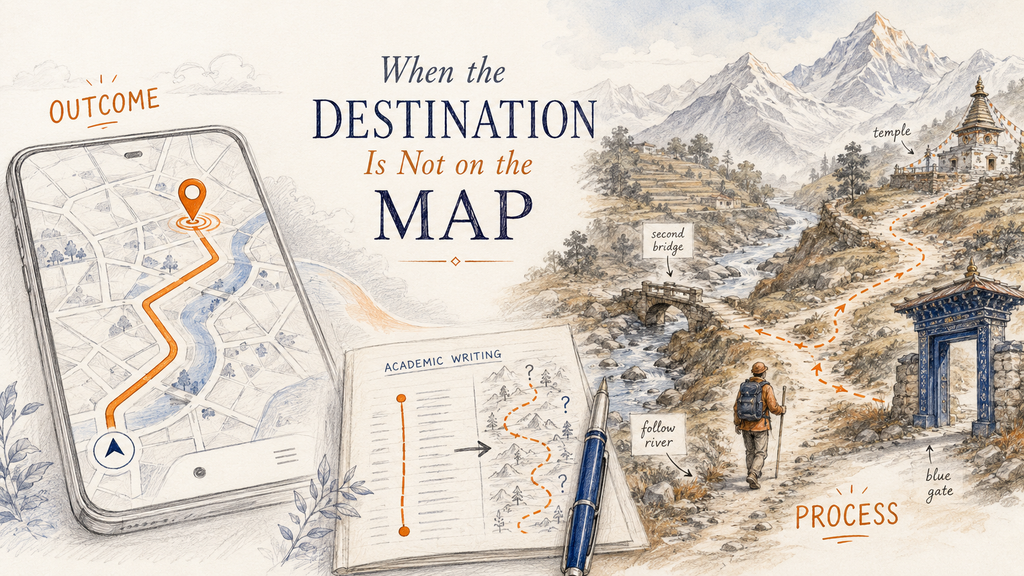
Academic writing is one of those unmapped villages.
Not because AI lacks data. It has read more published papers than you and I combined. It knows IMRaD structure. It can produce a structurally correct manuscript on command. But a comparative analysis in neurosurgery scored AI-generated scientific writing at 6.3 for technical accuracy versus 9.3 for human-written text. Reviewers noted the AI output “lacked depth, critical analysis, and contextual interpretation.”
Structurally correct and scientifically compelling are different things. The distance between them is made entirely of judgment calls AI cannot make on its own.
(BTW I recently published about academic judgement in the age of AI- you can read it HERE if interested)
Your Prompt Is a Specification, Not a Request
This is why I have become less interested in prompt engineering as a collection of clever ways to ask, and much more interested in specification. As Harvard Business Review argued, the enduring skill is problem formulation, not prompt crafting.
A specification is where your judgment lives. Every rule in it is a decision AI would otherwise make by itself (poorly), with limited expertise. A spec does not make the AI smarter. It makes your expertise legible enough for the AI to follow.
Here is the Persona(l) GOAL framework I built for this:
- P (Persona): The role AI should adopt. Editor, biostatistician, peer reviewer.
- G (Goal): The specific deliverable you need.
- O (Output): Length, structure, format.
- A (Avoid): What to leave out.
- L (Lens): Your study context, the constraints, the audience.
The Goal, Output, and Avoid define “what great looks like”. That is your destination. But for expert work, you need to add the path or the process: your decision logic, your workflow, the reasoning a top researcher in your subfield would apply.
Importance of Defining BOTH the Process & the Outcome
The Limitations subsection is the clearest proof. It is the section most researchers dread writing, the section most AI outputs butcher, and the section where the gap between “destination only” and “destination plus path” is widest.
I have reviewed hundreds of Limitations sections across manuscripts and AI outputs. They fall into 3 categories:
| Confessional | Dismissal | Reflection | |
|---|---|---|---|
| What it does | Lists problems without explaining their impact. Reads like an apology. | Admits then hand-waves. Tells the reader “just trust us.” | Connects design choices to specific uncertainties and tells the reader how to interpret findings. |
| Example | “We acknowledge a small sample size…” | “Although X is a limitation, it likely did not affect results…” | “Our decision to recruit from academic centers creates uncertainty regarding…” |
Ask any AI model to write a Limitations section right now, even with full context. It will default to Confessional or Dismissal.
What a reviewer wants is Reflection. The only way to get AI there is to build it into your specification. Tell the model to follow this 4-part framework for each limitation:
- Design choice: State what was done.
- Uncertainty: Name the specific uncertainty that choice creates.
- Implication: Explain what it means for generalizability, causality, or effect size.
- Future work: Suggest what would reduce this uncertainty.
Watch the difference.
Destination only:
“Write the Limitations subsection for my observational cohort study on disease clusters in psoriatic arthritis.”
This gets you Confessional or Dismissal. Guaranteed.
Destination plus path:
“Write the Limitations subsection. Structure each limitation as a Reflection, not a Confessional or Dismissal. For each limitation: (1) State the design choice we made, (2) Name the specific uncertainty it creates, (3) Explain the implication for generalizability, causality, or effect size, (4) Suggest what future work would reduce this uncertainty. Cover three limitations: single-center academic recruitment and its effect on phenotype capture, cross-sectional sampling rather than an inception cohort and its effect on cluster stability, and the high baseline severity in Cluster 3 and the risk of regression to the mean. Do not list more than four limitations. Do not offer generic hedging. Tone: honest, specific, and earned.”
The second prompt is longer. But it is also where the value lives. Every sentence in it is a judgment call that the model would have made differently, and worse, on its own.
When you give the model that second prompt, here is the kind of output it produces:
Several limitations should be considered when interpreting our results. First, our decision to recruit solely from academic centers with PsA expertise creates uncertainty regarding the full spectrum of disease phenotypes captured in this study. This selection bias likely explains why we did not identify a “mild PsA with severe psoriasis” cluster, as these patients may predominantly receive care in dermatology clinics rather than the rheumatology-focused sites in our consortium. Consequently, our clusters may not be fully generalizable to community practices where the distribution of disease severity differs.
Next, sampling patients at various disease stages rather than using an inception cohort introduces ambiguity regarding the observed stability of these clusters. It remains unclear whether this stability reflects intrinsic biological phenotypes or the stabilizing effects of prior long-term management.
Finally, the significant improvement observed in Cluster 3 (Severe PsA/Severe PsO) must be interpreted with caution. While this difference may suggest distinct treatment responsiveness, we cannot rule out the influence of regression to the mean, a statistical artifact common in longitudinal studies of high disease activity.
Design choice. Uncertainty. Implication. Future work. Every limitation follows that structure. Four sentences that turn a generic apology into a paragraph that earns a reviewer’s trust.
No AI model arrives at this on its own. This structure encodes judgment about what a reviewer needs and how a seasoned researcher earns credibility. That judgment does not live in the training data. It lives in you.
The Prompting Rules Worth Knowing in 2026
A few findings from the latest research:
- Goals outperform examples. Specifying the goal outperforms giving the model solved cases to mimic. Removing few-shot examples and replacing them with clear goals raised accuracy from 74% to 83.8%.
- 3 constraints per pass. Meta tested 15 models with up to 12 rules per prompt. At 8 rules, compliance dropped to 41%. At 12, only 5.7% got all rules right. If your spec has eight requirements, split the work across passes.
- Avoid leading questions. Testing 45 AI models showed that phrasing like “X is better, right?” biases the model toward agreement. “Compare X and Y for my situation” gets an honest assessment.
- Verify every citation. An audit of 2.6 million references found that 1 in 4 NeurIPS 2025 papers had a hallucinated citation that passed expert peer review. If trained reviewers cannot catch fabricated citations, you will not catch them by reading the text. Open every link.
This Week’s Action Step
Try the Limitations test. Ask any model to write a Limitations section for your current manuscript. Give it full context but no framework. See what you get.
Then feed it the 4-part Reflection structure above and run it again.
The difference will tell you everything you need to know about when the destination alone is enough and when you need to share the road.
(And that exactly why we built Research Boost around the proven frameworks for each specific manuscript and grant section and paragraph that I have perfected over the last decade. Try it FREE here.)
Top Papers on AI in research this week:
- Recovering Research Ideas from Bibliographies – Researchers stripped 643 papers down to their reference lists, then asked seven frontier models to reconstruct the original idea. Match rates landed between 3 and 15 percent. Adding cross-model review and tournament selection lifted that to 42 percent, which still leaves the creative leap largely unsolved.
- An Agent That Wrote Better Algorithms – The Little Scientist runs a full hypothesis, test, and revise loop, with a second agent injecting fresh framing when progress stalls. It produced a protein fitness method now ranked first on ProteinGym across 217 assays. A DNA motif algorithm it wrote beat STREME on 132 transcription factors and ran 11 times faster.
- Scoring AI Scientists Without Human Scaffolding – ASI-Bench asked 18 agent systems to run 60 real research projects across 11 fields. Scores fell from 50.9 with full methodological guidance to 26.6 when agents chose their own methods. Forty experts spent over 31,000 hours building the benchmark.
- Screening 200,000 Records for a Meta-Analysis – An LLM screening agent caught 43 of 44 eligible suicide prevention studies from a 201,064-record corpus. Sensitivity hit 97.7 percent and human workload dropped 99.4 percent. The full run cost $856. Agreement with human consensus (kappa 0.75) beat human-to-human agreement (kappa 0.64).
- Stigmatizing Language in Clinical Reasoning – Across 3,745 model-task pairs on real clinical data, reasoning models produced stigmatizing language more often than non-reasoning ones. Stigma rates correlated negatively with task accuracy. Roughly one in five pairs amplified stigma already present in the source notes. Prompt engineering cut rates by up to 92 percent with no accuracy penalty.
- Coding Adverse Events in Leukemia Trials – A retrieval-augmented pipeline mapped adverse events to MedDRA terms across three AML trial datasets. Clinicians judged 91 to 97 percent of the output acceptable. Exact low-level term matching stayed near half, so the real value sits in candidate generation rather than final assignment.
- Board Scores Overstate Clinical Reasoning – Swap the correct answer on a nephrology board question for “none of the other answers” and accuracy collapses. GPT-4o fell from 66 percent to 19 percent. GPT-5 held up best, dropping 14 points. Multiple choice benchmarks flatter these models more than they should.
- Where LLMs Break Research Workflows – TRACE logs failures across entire multi-step workflows instead of single prompts. Forty-five incidents over seven weeks clustered into verification failures, numerical errors, tool misunderstanding, and citation problems. One mistake carried an estimated $2,500 cost. Human reviewers agreed only weakly on how to categorize them.
- Fifty Agents Loose in Computational Chemistry – Agentic systems in computational chemistry grew from roughly six in 2024 to nearly fifty this month. They now design and run in silico experiments, analyze results, and draft manuscripts. Every reported system still keeps a human in the loop.
Top Papers on AI in education this week:
- Students Think AI Is Dulling Their Thinking – An analysis of 49 International Baccalaureate essays found 80 percent reporting that AI reliance reduces their own thinking. The authors propose a four-part framework covering cognition, agency, emotional well-being, and ethics. Their design rule is blunt: scaffold, do not substitute.
- Retrieval Beats Generation in Intro Programming – Rather than generating answers, this system points students to the exact lecture video segment that addresses their question. Gemini 3.1 Pro and GPT-5.4 Pro came close to an expert instructor at picking segments. A pilot with roughly 900 C programming students showed heavy use for revisiting fundamentals. Limiting the model to approved material sidesteps hallucination.
- What Students Actually Ask an AI Tutor – Researchers classified 830 student-AI exchanges from two CS2 assignments using an 18-category question taxonomy. A small handful of question types accounted for most inquiries. The mix shifted noticeably as students moved through the task.
- Study Habits Predict Persistence, Not Learning – Clustering EdNet logs from 5,000 learners surfaced eight study strategies, from reading-heavy to problem-first. Those clusters predicted persistence and course completion. They failed to predict later accuracy, which means engagement analytics are not mastery analytics.
- Two Layers of Refusal Improve AI Lesson Videos – Educators first revise AI-generated scripts against multimedia learning principles. Automated checks then flag broken lesson flow and mismatched narration. Testing with 23 educators across three subjects showed each layer improved instructional quality on its own.
- Embedding AI Literacy Across 18 Courses – LearnAI pairs short in-class AI sessions with one-on-one co-creation tutoring run by trained undergraduates. Thirty-five participants built 36 portfolio sites and more than 20 deployed web apps over two semesters. Interviews suggest students stopped treating the model as a passive answer machine.
- Adaptive Tutoring in Nigerian Pidgin – This platform fine-tunes an instruction-tuned model on a purpose-built Nigerian Pidgin dataset. The team compared 4-bit, 5-bit, and 8-bit quantization against automated metrics and native speaker judgments. Higher-bit versions preserved meaning better, while lower-bit versions ran faster on constrained hardware.