

Academia is facing a quiet crisis.
We keep saying the goal is simple — “get good science published”.
But most of our fixes aim at what’s easiest to police, not what actually matters.
Instead of protecting “good” science, we may be punishing real researchers.
Here’s where academia is pointing its firepower at the wrong targets — and what a better way forward could look like.
1️⃣ “Anything AI is bad” — fighting the wrong war
The paranoia around AI detection has gone off the rails.
Turnitin rolled it out.
Journals experimented with it.
Every few months, a new “AI detector” claims it can catch the bad guys.
And yet, the real goal hasn’t changed: publish honest, reproducible science.
Somewhere along the way, we traded that for something convenient — who typed which sentence.
The uncomfortable facts
1️⃣ The detectors just don’t work.
Even OpenAI itself shut down its own AI classifier for having “low accuracy.”
If the people who built the models can’t tell AI text from human text, what are we doing pretending we can?
2️⃣ They’re biased.
A Stanford/Patterns study found that multiple detectors disproportionately flag non-native English writing as “AI,” while native writing often passes.
That’s not research integrity — that’s accent policing in text.
3️⃣ Institutions already learned this lesson the hard way.
A major Australian university ran nearly 6,000 AI-misconduct cases using Turnitin’s AI detector, then had to backtrack after multiple false accusations.
The regulator later admitted that AI cheating is “all but impossible to detect reliably.”
4️⃣ Even the companies behind these tools admit the problem.
Turnitin’s own documentation and campus reports concede high false-positive rates.
Several universities have quietly disabled the feature altogether.
In my own experience, when you run the same text through the different AI detectors (and there are dozens of them, all claiming to be the best) and you’ll get very different results.
That’s not evidence — that’s just noise.
We’re guarding the front door while the lab’s back door is wide open
AI can help with brainstorming, summarizing, simulation, even cleaning up language.
None of that is the threat.
The real threat is bad science dressed up as a paper — post-hoc hypotheses, unreported code, selective reporting, underpowered studies, zero replication.
Counting “AI-touched sentences” is the laziest possible proxy for quality.
It’s visible. It’s scoreable.
And completely irrelevant to whether a finding holds up.
If we care about research integrity, stop asking “who wrote this?” and start asking “is this defensible?”
COPE, ICMJE, WAME — the people who actually set publication ethics — aren’t calling for AI bans.
They’re calling for disclosure, accountability, and human responsibility.
AI can assist, but it can’t be an author.
And the person submitting the paper must own it.
That’s the middle ground worth defending.
2️⃣ “All public-database studies are junk” — the lazy conclusion
I started my research career with open datasets — NHANES, NIS, SEER.
Most of us probably did.
I had no access to institutional databases. No mentor with data to share. Just curiosity and whatever was freely available.
Those were my first datasets.
They taught me how to ask questions, how to design studies, and how to write.
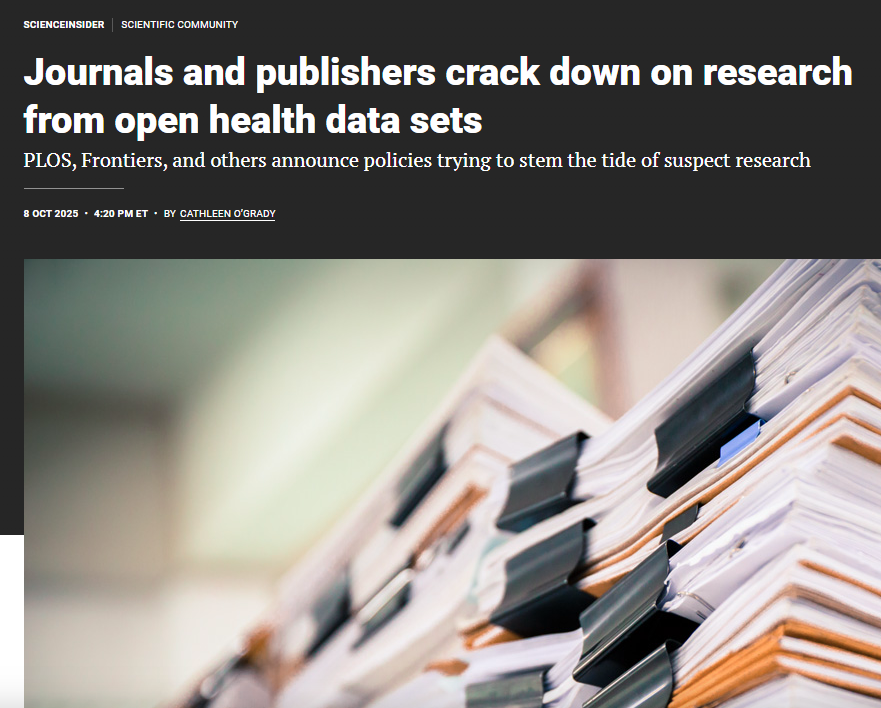
Now, those same databases trigger desk rejections.
What actually changed
- The flood of one-off correlation papers. A PLOS Biology meta-research study found 341 NHANES papers that followed the same formula: one nutrient, one outcome, minimal theory, and weak confounder control. That’s not science — that’s slot-machine epidemiology.
- Editors had enough. PLOS tightened screening, and the rejection rate jumped from 40% to 94% in one month.
- Frontiers reported the same trend. Their editors documented a five-fold surge in NHANES submissions across 2023–2024 — with 60 desk rejections in Frontiers in Medicine alone, mostly for weak methods and templated writing.
So the dataset isn’t the enemy.
The problem is shallow analysis.
Open data isn’t the issue — lazy work is
NHANES remains one of the most valuable national health datasets we have.
Used well, it can shape policy and reveal undiagnosed disease trends.
Strong studies are still being done.
For instance, a recent JAMA Network Open paper built a validated nutrition-security index from NHANES cycles — carefully, transparently, and reproducibly.
That’s what credible, public-data research looks like.
So no, “NHANES = junk” is lazy.
The right formula is: untheorized, unreplicated association-hunting = junk.
3️⃣ “All non-invited reviews are junk” — the blunt filter
Let’s call it what it is: reviews have become the easiest target for editorial triage.
Not because reviews don’t matter — they do.
But because the volume is exploding, the quality is uneven, and the reviewer pool is exhausted.
So journals are using the bluntest tools they have:
“invited only,” “pitch first,” or desk-reject on sight if it looks generic or AI-assisted.
Desk rejections are now the norm
- Half or more submissions across major publishers get desk-rejected before peer review.
- Frontiers doubled its early rejections from 17% in 2022 to 33% in 2024 — most before review.
Reviews are easy to screen out.
They look repetitive, and “invited” has become shorthand for “trusted.”
Early-career researchers rarely make it past that first filter.
Why reviews get hit hardest
- Easy to generate, hard to judge quickly.
- “Invitation” becomes a trust signal, shutting out new voices.
- They lack preregistration or structured methods, so they look suspicious by default.
Reviewer fatigue is real.
So journals are triaging faster, harsher, and often blindly.
It’s not about quality anymore — it’s about convenience.
All these problems existed before. AI just made them louder.
Blanket bans and hard filters might make life easier for editors.
But they punish the wrong people — the serious researchers who rely on open data and the early career researchers who just need a fair shot.
If you’re using public datasets today, you’ll need to show real rigor — external validation, new analyses, or genuine insight.
The era of “download → regress → publish” is over.
Should we use AI to screen for quality?
Not like this.
If AI writes it and AI judges it, we’ll spend our time trying to outsmart the judge-AI — instead of improving the science.
But that doesn’t mean AI can’t help.
There’s a smarter way forward.
What academia can learn from social platforms
Twitter/X optimized for what’s easy to measure — clicks, outrage, virality.
That’s how it collapsed into noise.
LinkedIn, for all its flaws, optimized for what’s harder to fake — saves, dwell time, thoughtful comments.
It never banned AI-written posts.
It quietly rewarded “value”.
Over time, the system learned to surface content that teaches and inspires, not just provokes.
That’s exactly what academia needs.
Stop banning tools.
Reward rigor.
Reward original thought.
Reward original ideas.
Because that’s what moves science forward —
not how it was written, but why it was worth writing.
The playbook — how to fix what’s broken
1️⃣ Make method quality the gate
- Pre-specify or label exploratory work. If you fished, say it. Call it hypothesis-generating. That’s fine — just be transparent.
- Match the checklist to the claim. STROBE, CONSORT, PRISMA, SANRA, TRIPOD — use the right one. If it doesn’t fit the standard, it doesn’t pass triage.
- Make reproducibility the default. Share code, logs, and data-access notes. If others can’t rerun it, it’s not ready.
2️⃣ Use AI as a rigor co-pilot, not an authorship cop
- Let AI flag missing weights, leakage, or unadjusted multiplicity. Humans review, not machines.
- Be open about where AI helped — literature searches, figure drafts, code cleanup. Transparency builds trust.
- Editors should use secure, enterprise-grade models — not public APIs — for checks. (I realize this is controversial for now, but with the explosion of paper-mills, we might not have a choice.)
3️⃣ Keep the door open for public-data research
- Respect survey design (weights, strata, PSUs). Show your code.
- Control for multiplicity (FDR, Bonferroni, whatever’s appropriate).
- Validate across cycles or datasets.
- Right-size your claims — association ≠ causation.
4️⃣ Create transparent paths for non-invited reviews
- Require a short pitch that shows review type, framework, and what new synthesis it adds.
- Archive search strings, screening logs, and figure code.
- Pair early-career reviewers with senior editors — same bar, fair support.
5️⃣ Rewire incentives to reward what matters
- Add visible badges for reproducibility, preregistration, and replication.
- Fast-track transparent submissions.
- Highlight reuse — code forks, dataset citations, replications — alongside citations.
6️⃣ Triage like LinkedIn, not like a metal detector
- Promote content that adds real value — methods, reproducibility, usable data.
- Demote oversold, clickbait-like studies and templated reviews.
- Retire AI-authorship detectors. They’re easy to game and punish the wrong crowd.
7️⃣ Where AI fits in reviews — real talk
AI isn’t deterministic or replicable.
So it can’t be your method.
But it can accelerate almost every step — translating search strings, screening abstracts, extracting structured data — under human supervision, with full transparency.
AI is the muscle, not the mind.
The mindset shift
Stop banning tools.
Stop labeling datasets.
Stop closing doors.
Raise the floor instead.
Reward transparency, reproducibility, and clarity.
Make rigor the path of least resistance.
Because the real question isn’t “Was this written with AI?”
It’s “Does this move science forward?”
That’s the kind of science worth defending.
The question is: Do we want to teach the next generation of researchers how to think —
or how to avoid getting flagged?
PROMPT OF THE WEEK
Internal grant reviewer
→ **Persona**(l): “Act as an expert NIH reviewer in [your field]”

→ **G**oal: “I want NIH-style feedback on Aim 2 of my grant.”

→ **O**utput Format: “Give 3 strengths, 3 weaknesses, and suggestions to improve clarity and feasibility.”

→ **A**void: “Avoid generic advice. Focus on issues that would concern a standing NIH study section.”

→ **L**ens of Context: “I’m a physician-scientist interested in improving personalized medicine in PsA. This is my second submission. The aims have been refined based on prior reviewer feedback. This is my specific aims page: [- - -copy and paste your aims page . . .]”
P.S. Research Boost AI is live. This is an agentic AI system built on the same principles that I describe here. It turns your scattered notes into well structured manuscript drafts with vetted, high-quality citations— in hours, not weeks. Zero complicated prompting required.
(And NO we don’t have or promote any AI detectors on the platform. We promote how to do good science and communicate it well.)
Sign up here to get 5,000 words FREE today: