

I used to spend 3–4 hours on the first paragraph of a manuscript.
Just one paragraph.
Each sentence was a tug-of-war between clarity and jargon. I’d write, rewrite, reread, then stare at the blinking cursor wondering if I was overthinking it.
Then one day, I dumped my messy draft into ChatGPT.
What came back wasn’t perfect. But it was something.
It helped me get unstuck.
That was the first time I realized something important:
Use AI to speed up your thinking. Not to replace it.
And that single idea has transformed how I work.
But here’s the nuance we often miss
AI isn’t good at everything. It doesn’t improve everything evenly. It doesn’t fail gracefully.
It has a jagged frontier.
AI is brilliant at some tasks and terrible at others that seem equally hard.
Some creative tasks? It nails them. Basic math? It might still mess it up.
Why?
Because AI doesn’t operate on a smooth curve of ability. Picture an uneven wall surrounding a fortress. Inside the wall? Tasks AI handles well. Outside? It struggles.
Two tasks may appear equally complex to a human, but fall on opposite sides of that invisible wall.
This is the Jagged Frontier.
Real-world data: AI’s stunning effect on knowledge work
In a massive, pre-registered experiment at Boston Consulting Group, over 750 consultants were split into groups. Some used GPT-4. Some didn’t.
The results?
- 12.2% more tasks completed by those using AI
- 25.1% faster completion time
- 40% higher quality of output
These weren’t cherry-picked prompts. These were real consulting tasks: market segmentation, idea generation, press releases, persuasive memos—all modeled on actual consulting deliverables.
And across the board, the AI-enhanced groups outperformed.
But here’s the twist:
One specific task was designed to trip up the AI. It required domain reasoning in a way LLMs currently fumble.
Consultants who used AI on that task did worse. They were confident—but wrong. They “fell asleep at the wheel.”
This is what the authors call automation-induced complacency: when AI performs well enough, we stop thinking critically.
So how do we navigate the Jagged Frontier?
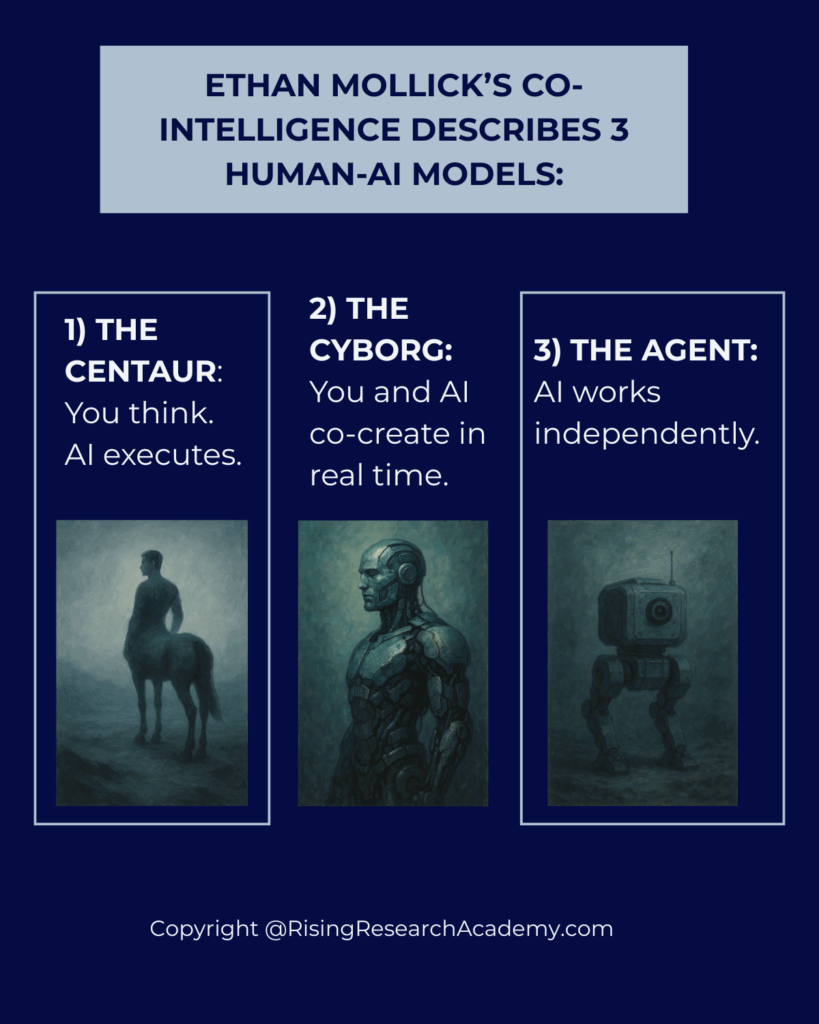
We adopt one of 2 approaches:
1. The Centaur Model
You do what you’re good at. AI does what it’s good at.
There’s a clear division of labor.
Examples:
- You interpret results. AI generates plots.
- You outline a response to reviewers. AI rewrites for tone and clarity.
- You write a detailed outline. AI writes the section for you.
2. The Cyborg Model
You and AI work side-by-side, fluidly.
You write the introduction and when you are stuck, you ask AI to provide you with ideas to continue.
After some back and forth, you choose one of the ideas and ask AI for some suggestions on the text.
OR you could ask AI to suggest how you could improve your argument for a finding in the discussion. AI suggests an argument with citations (which you double-check).
You’re co-creating, constantly reviewing, course-correcting.
This is the model I predominantly use when writing.
There is a third model that has been proposed (and is all the hype)…
3. The Agent Model
This is where a set of AIs performs entire tasks on its own—autonomously.
The promise is appealing: “Give the AI a goal and let it do the work.”
But here’s the reality:
We are nowhere near this being viable in clinical research.
Agents still hallucinate, misinterpret context, and lack domain awareness. Fully autonomous work, without oversight, is dangerous and unrealistic.
This is more true in clinical research where errors can be fatal.
So no matter how advanced the AIs get, we will always need a human in the loop.
For now, Agents are a concept. Centaur and Cyborg are the actionable models.
What I Delegate to AI (and What I Don’t)
✅ I let AI handle:
- First drafts from notes or outlines
- Clarifying a messy paragraph
- Grammar, tone, flow
- Summarizing papers (with manual fact-checking)
❌ I never delegate:
- Interpretation of clinical or statistical results
- Novel hypothesis development
- Reviewer rebuttals
- Final abstract or discussion section
These require domain expertise. And they define your credibility.
5 Lessons for Clinical Researchers Working with AI
1. Map your jagged frontier
AI is not uniformly smart. Its brilliance is scattered—and unpredictable.
It might write a compelling introduction section. Then fail basic statistical interpretation.
That’s the jagged frontier: a messy, invisible boundary between what AI does well and what it does poorly.
As a researcher, your job is to learn where those edges lie. That only comes through deliberate use and critical review.
Start by testing AI on the tasks you perform weekly. Then keep a mental map:
- ✅ Where it helps
- ⚠️ Where it’s unreliable
- ❌ Where it’s dangerous to trust
Your future workflows will depend on this map.
2. Choose your model: Centaur or Cyborg
You don’t need to use AI the same way across tasks.
Pick your collaboration style based on the task:
Centaur: Clear division of labor. You think, AI formats.
Cyborg: Constant handoff. You nudge. AI drafts. You edit. AI refines.
For example:
- Use Centaur mode for writing figure legends, cleaning grammar, summarizing PDFs.
- Use Cyborg mode for ideation, outlining, or refining reviewer responses.
Both are valid. Just be intentional. Let the task dictate the method.
3. Don’t fall asleep at the wheel
Here’s where clinical researchers often slip.
When AI sounds smart, we relax our guard. We assume it’s right. Especially when the output feels polished.
That’s where mistakes happen.
In the BCG study, consultants using AI underperformed on a task specifically designed to trip up LLMs. Why?
Because they stopped thinking critically.
Automation-induced complacency is real. And it’s risky.
In clinical research, where precision matters—every AI output must be reviewed with rigor.
👉 Don’t just use AI. Audit it. Question it. Re-verify sources. Check logic.
The moment you stop thinking critically, you’ve handed over your credibility.
4. Let AI level the playing field—but don’t let it define the game
In the BCG study, consultants who started with lower baseline scores showed the biggest boost when using AI. That’s encouraging.
It means AI can democratize research capacity.
If you’re early in your career, AI can help you move faster, structure your thinking, and bridge technical gaps.
But here’s what’s just as important:
The highest-performing researchers still outperformed—because they added their own judgment, domain knowledge, and nuance.
Let AI lift you up. But don’t let it lead.
The goal is not parity. It’s partnership.
Domain expertise is going to be more valuable and rare in the AI era.
5. Always keep human in the loop
There’s growing noise about “agents” and fully autonomous workflows.
Ignore the hype—for now.
AI agents can string together tasks, use APIs, and simulate human workflows. But they still hallucinate. They still misinterpret nuance. They still lack context.
And in research, that’s unacceptable.
Your research isn’t a to-do list. It’s a layered, iterative process built on expertise, integrity, and clarity.
So no matter how far AI advances:
Keep your hand on the wheel.
Keep your brain in the loop.
Keep your name tied to only what you truly stand behind.
Use AI to expand your impact—not replace your role.
AI is here now. And it’s only expanding.
This isn’t hype. The very tools used in the BCG study? They’re available to you today.
And we already have more powerful models.
And mind you, these are the worst AI models you will ever use.
So the question isn’t: “Should I start using AI in my research?”
The question is: “How can I use AI responsibly and effectively before I’m left behind?”
Start here:
→ Download my FREE guide: How to Start Using AI for Research Today
Use AI to extend your brain—not replace it.
Just remember to keep your hand on the wheel.